Open-source RightAI Tools Directory
  • Discover AI
  • Submit
  • Startup
  • Blog
Open-source RightAI Tools Directory
Discover the best AI tools of 2025 with the RightAI Tools Directory!

Friend Links

AI Anime GeneratorToolsApp AI

Support

Tap4
Privacy policyTerms & ConditionsContact Us
Loading...
loading...

Spaceduck Web Clipper

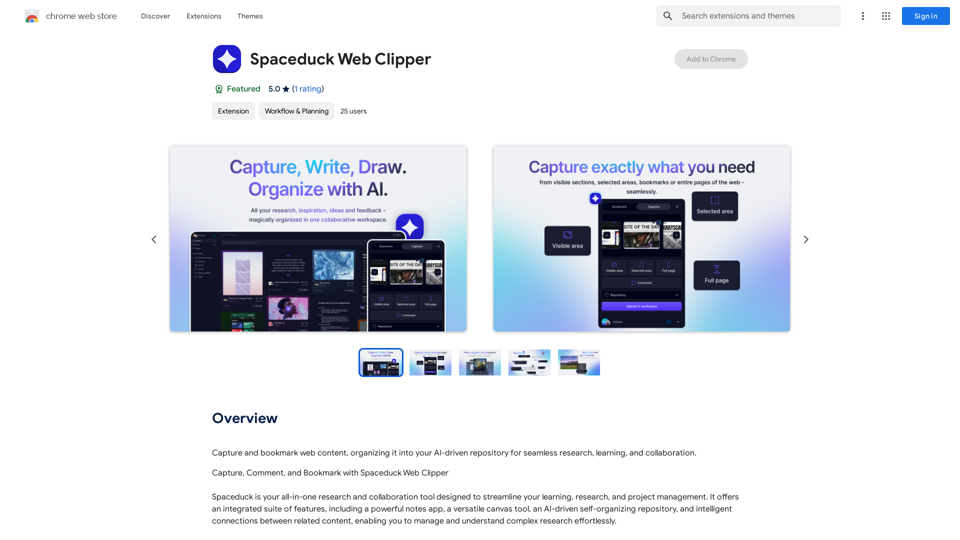
Save and mark web pages, putting them into your smart, AI-powered collection for easy research, learning, and working together.
Visit Website
Spaceduck Web Clipper
Visit Website

Introduction

Spaceduck Web Clipper is an AI-powered browser extension designed to enhance web research, learning, and collaboration. It allows users to capture, bookmark, and organize web content into an intelligent repository. The tool leverages AI technologies for text generation and image understanding, creating a seamless experience for managing complex research and discovering new insights.

Feature

Capture and Organize Web Content

Spaceduck Web Clipper enables users to take screenshots, leave live comments, and bookmark pages. All captured content is automatically organized within the user's Spaceduck workspace.

AI-Driven Repository

The extension creates a self-organizing repository for captured content, making it easy to manage and understand complex research effortlessly.

Intelligent Connections

Spaceduck Web Clipper connects related content, allowing users to explore and discover new insights and relationships within their captured information.

Chrome Extension

Available as a Chrome browser extension, Spaceduck Web Clipper is easily accessible and integrates seamlessly with users' browsing experience.

Free to Use

The basic version of Spaceduck Web Clipper is free, with no subscription fees or costs. Some advanced features may require a subscription.

Collaboration Tools

The extension offers shareable notes and highlights, enhancing collaboration possibilities among researchers and teams.

FAQ

How do I get started with Spaceduck Web Clipper?

  1. Install the extension from the Chrome Web Store
  2. Use the extension to capture and bookmark web content
  3. Explore your AI-driven repository to discover insights and connections

What are the main benefits of using Spaceduck Web Clipper?

  • Streamlined research process
  • Enhanced collaboration through shareable notes
  • AI-powered insights and connections
  • Efficient organization of complex information

Are there any tips for maximizing the use of Spaceduck Web Clipper?

  1. Use the extension regularly to build a valuable content repository
  2. Organize your captured content effectively using the AI-driven features
  3. Explore the intelligent connections to uncover new insights and relationships

Latest Traffic Insights

  • Monthly Visits

    193.90 M

  • Bounce Rate

    56.27%

  • Pages Per Visit

    2.71

  • Time on Site(s)

    115.91

  • Global Rank

    -

  • Country Rank

    -

Recent Visits

Traffic Sources

  • Social Media:
    0.48%
  • Paid Referrals:
    0.55%
  • Email:
    0.15%
  • Referrals:
    12.81%
  • Search Engines:
    16.21%
  • Direct:
    69.81%
More Data

Related Websites

Luxi | Discover Items in Images Automatically
View Detail

Luxi | Discover Items in Images Automatically

Luxi | Discover Items in Images Automatically

Luxi.ai uses advanced image recognition technology to easily identify objects in uploaded images. Discover the items in your photos with precision and ease.

1.73 K
Prompt Support
View Detail

Prompt Support

Prompt Support

Maximize the Effectiveness of Your GPT Engine Prompts 1. Be Clear and Specific: * Instead of: "Write about dogs." * Try: "Write a 500-word essay about the history and characteristics of Golden Retrievers." 2. Provide Context: * Instead of: "Summarize this article." * Try: "Summarize the main arguments presented in this article about the impact of social media on teenagers." 3. Set the Tone and Style: * Instead of: "Write a story." * Try: "Write a humorous short story about a cat who thinks it's a dog." 4. Define the Desired Format: * Instead of: "Create a poem." * Try: "Write a rhyming sonnet about the beauty of a sunset." 5. Use Examples: * Instead of: "Generate some creative writing ideas." * Try: "Generate some creative writing ideas similar to the style of Edgar Allan Poe." 6. Break Down Complex Tasks: * Instead of: "Write a business plan." * Try: * "Outline the key components of a business plan for a new coffee shop." * "Write a section of the business plan focusing on the target market." 7. Refine Your Prompts: * Experiment with different wording: See what yields the best results. * Iterate on your prompts: Build upon previous responses to get closer to your desired outcome. By following these tips, you can craft more effective prompts that will help you get the most out of your GPT engine.

193.90 M
ChatGPT Assistant - MyBrainOnAI
View Detail

ChatGPT Assistant - MyBrainOnAI

ChatGPT Assistant - MyBrainOnAI

Prompt Library Personal Library Tools to enhance using ChatGPT Tools to create prompts Improve your productivity and results

193.90 M
HelpMeTeach - AI Simplifies Teaching | Lesson Plans, Assessments, and More!
View Detail

HelpMeTeach - AI Simplifies Teaching | Lesson Plans, Assessments, and More!

HelpMeTeach - AI Simplifies Teaching | Lesson Plans, Assessments, and More!

Revolutionize your teaching with HelpMeTeach, the premier AI assistant for teachers. Simplify lesson plans and assessments, generate ideas, and create reports with ease. Enhance work-life balance and reduce workload with our 70+ teacher tools. Start now!

1.62 K
Voice, dim.
View Detail

Voice, dim.

Voice, dim.

Control the brightness of your lights with your voice.

193.90 M
Notion AI Pro
View Detail

Notion AI Pro

Notion AI Pro

The Best Alternative to a Notion AI Subscription.

193.90 M
AIDEA
View Detail

AIDEA

AIDEA

Interfacing with AI This document explores the various ways humans interact with artificial intelligence (AI). Types of Interfaces * Text-based Interfaces: These interfaces allow users to communicate with AI systems through written language. * Examples include chatbots, command-line interfaces, and search engines. * Voice-based Interfaces: Users interact with AI using spoken words. * Examples include virtual assistants like Siri, Alexa, and Google Assistant. * Graphical User Interfaces (GUIs): These interfaces use visual elements like icons, buttons, and menus to enable interaction with AI. * Examples include AI-powered image editing software and virtual reality experiences. * Gesture-based Interfaces: Users control AI systems through physical movements. * Examples include motion-controlled gaming and sign language recognition. Challenges of AI Interfacing * Natural Language Understanding (NLU): AI systems struggle to fully understand the nuances of human language. * Contextual Awareness: AI often lacks the ability to understand the broader context of a conversation or interaction. * Personalization: Creating AI interfaces that are tailored to individual user preferences and needs can be complex. * Ethical Considerations: * Bias in AI algorithms can lead to unfair or discriminatory outcomes. * Privacy concerns arise when AI systems collect and process personal data. Future of AI Interfacing * More Natural and Intuitive Interactions: Advancements in NLU and machine learning will lead to AI systems that can understand and respond to human input more naturally. * Multi-modal Interfaces: Future interfaces will likely combine multiple input methods (e.g., text, voice, gesture) for a richer and more immersive experience. * Personalized AI Assistants: AI assistants will become increasingly personalized, anticipating user needs and providing customized support. * Ethical AI Development: * Researchers and developers will continue to work on mitigating bias and ensuring responsible use of AI.

193.90 M
Met Genius Extension
View Detail

Met Genius Extension

Met Genius Extension

The Power of React and TypeScript for Building Interactive Chrome Extensions React and TypeScript are a powerful combination for developing engaging and robust Chrome extensions. Here's why: * React's Component-Based Architecture: React's component-based approach makes building complex UIs for your extensions manageable and reusable. * TypeScript's Static Typing: TypeScript's type system catches errors early in development, leading to more reliable and maintainable code. * Improved Developer Experience: Both React and TypeScript offer excellent tooling and a strong community, making development smoother and more enjoyable. By leveraging these technologies, you can create Chrome extensions that are: * Interactive and User-Friendly: React's declarative style and virtual DOM enable smooth and responsive user interfaces. * Scalable and Maintainable: TypeScript's type safety and React's component structure promote code organization and extensibility. * Bug-Free and Reliable: TypeScript's static typing helps prevent runtime errors, resulting in more robust extensions. Let's explore how to harness the power of React and TypeScript to build your next amazing Chrome extension!

193.90 M