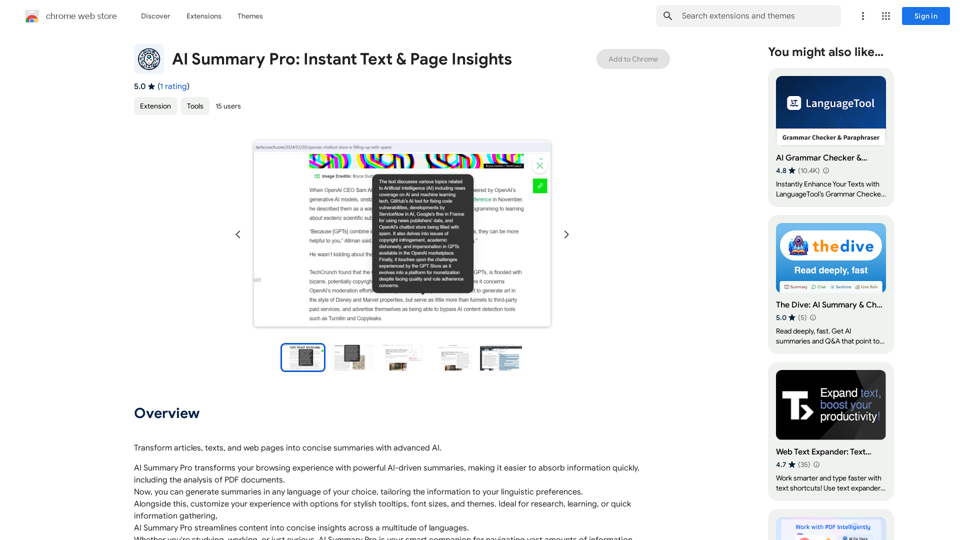
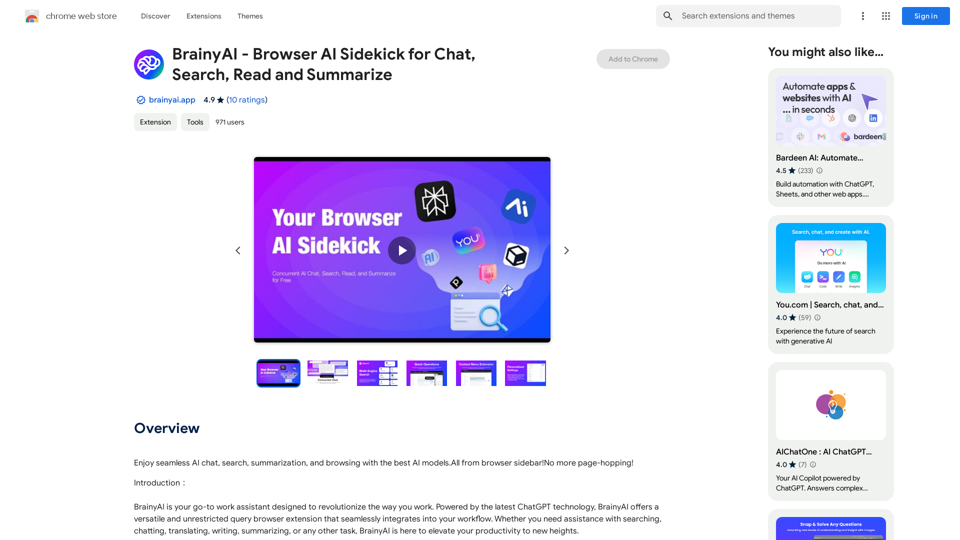
AI Summary Pro is an innovative Chrome extension that leverages artificial intelligence to generate concise summaries of articles, texts, and web pages. This powerful tool enables users to quickly grasp essential information, supporting efficient research, learning, and decision-making processes. With customizable features and multi-language support, AI Summary Pro caters to a diverse range of users, from students to professionals, seeking to optimize their information consumption.
AI Summary Pro swiftly analyzes and condenses content from various sources, providing users with quick access to key information. This feature is particularly useful for:
Rapid information gathering
Efficient research
Time-saving content review
Customizable Experience
Users can tailor their summarization experience with:
Stylish tooltips
Adjustable font sizes
Various theme options
These customization options ensure a personalized and comfortable reading experience.
Multi-Language Support
AI Summary Pro offers summaries in any language, making it an invaluable tool for:
International research
Language learning
Global information access
Easy Installation and Usage
Add AI Summary Pro to Chrome from the Web Store
Right-click to summarize selected text or entire pages
Slash Commands for ChatGPT and Bard
=====================================
Introduction
Slash commands are a convenient way to interact with ChatGPT and Bard, allowing you to perform various tasks and actions within the chat interface. This guide provides an overview of the available slash commands for both ChatGPT and Bard.
ChatGPT Slash Commands
#General Commands
* `/help`: Displays a list of available slash commands and their descriptions.
* `/reset`: Resets the conversation, clearing all previous messages and context.
#Conversation Management
* `/start`: Starts a new conversation, allowing you to begin a fresh topic or task.
* `/stop`: Ends the current conversation, stopping any ongoing tasks or topics.
#Language and Tone
* `/lang <language_code>`: Sets the language for the conversation (e.g., `/lang en` for English).
* `/tone <tone>`: Adjusts the tone of the responses (e.g., `/tone formal` for formal tone).
#Task Management
* `/task <task_name>`: Creates a new task or topic for the conversation (e.g., `/task math problem`).
* `/done`: Marks the current task as completed.
#Information and Resources
* `/define <word>`: Provides the definition of a word or phrase.
* `/wiki <topic>`: Displays information about a topic from Wikipedia.
Bard Slash Commands
#General Commands
* `/help`: Displays a list of available slash commands and their descriptions.
* `/reset`: Resets the conversation, clearing all previous messages and context.
#Conversation Management
* `/start`: Starts a new conversation, allowing you to begin a fresh topic or task.
* `/stop`: Ends the current conversation, stopping any ongoing tasks or topics.
#Language and Tone
* `/lang <language_code>`: Sets the language for the conversation (e.g., `/lang en` for English).
* `/tone <tone>`: Adjusts the tone of the responses (e.g., `/tone formal` for formal tone).
#Task Management
* `/task <task_name>`: Creates a new task or topic for the conversation (e.g., `/task math problem`).
* `/done`: Marks the current task as completed.
#Information and Resources
* `/define <word>`: Provides the definition of a word or phrase.
* `/wiki <topic>`: Displays information about a topic from Wikipedia.
* `/news <topic>`: Displays news articles related to a specific topic.
Conclusion
Slash commands provide a convenient way to interact with ChatGPT and Bard, allowing you to manage conversations, adjust language and tone, and access various resources. By mastering these commands, you can optimize your experience and get the most out of your interactions with these AI models.
Interfacing with AI
This document explores the various ways humans interact with artificial intelligence (AI).
Types of Interfaces
* Text-based Interfaces: These interfaces allow users to communicate with AI systems through written language.
* Examples include chatbots, command-line interfaces, and search engines.
* Voice-based Interfaces: Users interact with AI using spoken words.
* Examples include virtual assistants like Siri, Alexa, and Google Assistant.
* Graphical User Interfaces (GUIs): These interfaces use visual elements like icons, buttons, and menus to enable interaction with AI.
* Examples include AI-powered image editing software and virtual reality experiences.
* Gesture-based Interfaces: Users control AI systems through physical movements.
* Examples include motion-controlled gaming and sign language recognition.
Challenges of AI Interfacing
* Natural Language Understanding (NLU): AI systems struggle to fully understand the nuances of human language.
* Contextual Awareness: AI often lacks the ability to understand the broader context of a conversation or interaction.
* Personalization: Creating AI interfaces that are tailored to individual user preferences and needs can be complex.
* Ethical Considerations:
* Bias in AI algorithms can lead to unfair or discriminatory outcomes.
* Privacy concerns arise when AI systems collect and process personal data.
Future of AI Interfacing
* More Natural and Intuitive Interactions: Advancements in NLU and machine learning will lead to AI systems that can understand and respond to human input more naturally.
* Multi-modal Interfaces: Future interfaces will likely combine multiple input methods (e.g., text, voice, gesture) for a richer and more immersive experience.
* Personalized AI Assistants: AI assistants will become increasingly personalized, anticipating user needs and providing customized support.
* Ethical AI Development:
* Researchers and developers will continue to work on mitigating bias and ensuring responsible use of AI.
That's a great idea!
To make automated reviews, we need to figure out what kind of reviews you want to automate.
For example:
* Product reviews: Analyzing customer feedback to identify common themes and sentiment.
* Code reviews: Using tools to automatically check for coding errors and style inconsistencies.
* Academic paper reviews: Summarizing key findings and identifying potential areas for improvement.
Tell me more about the type of automated reviews you have in mind, and I can give you more specific information and examples.