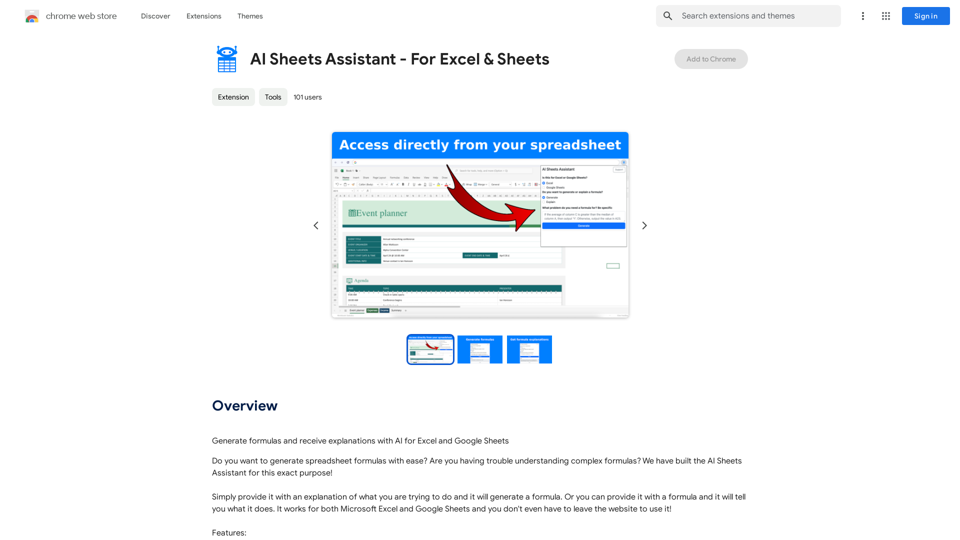
AI Sheets Assistant is a powerful extension designed for Excel and Google Sheets users. It leverages artificial intelligence to generate complex formulas and provide detailed explanations, enhancing productivity and understanding in spreadsheet work. This tool seamlessly integrates with your existing spreadsheet environment, offering a user-friendly interface and quick access to advanced formula creation and interpretation.
AI Sheets Assistant - For Excel & Sheets
Generate Formulas and Receive Explanations with AI for Excel and Google Sheets
This is a powerful tool that can help you with your spreadsheet work!
Here's how it works:
1. You describe what you want to achieve. Be as specific as possible. For example, instead of saying "I need a formula to calculate the total," say "I need a formula to calculate the total of sales in column B."
2. The AI will generate a formula for you. It will also provide an explanation of how the formula works.
3. You can copy and paste the formula into your spreadsheet.
Here are some examples:
* "I need a formula to find the average of the numbers in cells A1 to A10."
* Formula: `=AVERAGE(A1:A10)`
* Explanation: The `AVERAGE` function calculates the average of a range of cells. In this case, it will calculate the average of the numbers in cells A1 through A10.
* "I need a formula to count the number of cells that contain the word 'apple' in column C."
* Formula: `=COUNTIF(C:C,"apple")`
* Explanation: The `COUNTIF` function counts the number of cells in a range that meet a certain criteria. In this case, it will count the number of cells in column C that contain the word "apple".
* "I need a formula to find the largest number in column D."
* Formula: `=MAX(D:D)`
* Explanation: The `MAX` function returns the largest number in a range of cells. In this case, it will return the largest number in column D.
Let me know what you'd like to calculate, and I'll do my best to help!
Introduction
Feature
Formula Generation
AI Sheets Assistant can generate complex formulas based on user input, simplifying the process of creating advanced spreadsheet functions.
Formula Explanation
The extension provides clear explanations for generated formulas, helping users understand the logic and functionality behind each calculation.
Cross-Platform Compatibility
AI Sheets Assistant works with both Microsoft Excel and Google Sheets, offering versatility for different spreadsheet environments.
In-Spreadsheet Access
Users can access AI Sheets Assistant directly from their spreadsheet, eliminating the need to switch between applications.
User-Friendly Interface
The extension features a simple and intuitive interface, making it easy for users of all skill levels to navigate and utilize its capabilities.
Responsive Support
Fast and friendly customer support is available to assist users with any questions or issues they may encounter.
Free-to-Start Model
AI Sheets Assistant offers a free tier, allowing users to explore its features without initial cost. Advanced features and support are available through paid plans.
FAQ
How do I use AI Sheets Assistant?
To use AI Sheets Assistant, simply provide a description of your desired formula or calculation. The AI will then generate the appropriate formula. Alternatively, you can input an existing formula, and the assistant will explain its function.
Is AI Sheets Assistant compatible with both Excel and Google Sheets?
Yes, AI Sheets Assistant is designed to work seamlessly with both Microsoft Excel and Google Sheets platforms.
Is there a cost associated with using AI Sheets Assistant?
AI Sheets Assistant offers a free-to-start model with no initial subscription or payment required. However, advanced features and additional support may be available through paid upgrade options.
Related Websites

Beanbag is your AI assistant, residing in the browser sidebar, answering questions, summarizing translations of web pages, papers, and videos, and even helping you write emails quickly.
193.90 M
AI Text Shortener | Precise Text Adjuster | WordLimiter
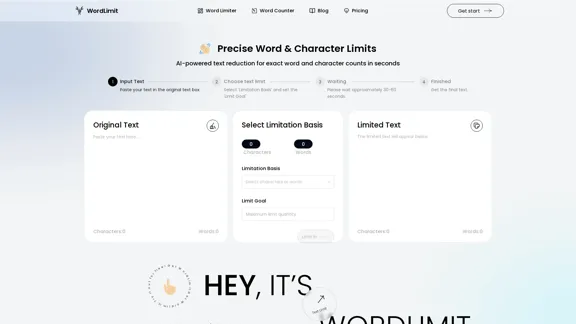
AI Text Shortener | Precise Text Adjuster | WordLimiterWordLimit helps you to shorten your text precisely without losing key information and your unique writing style. Feel free to use it because it will never make your Human-Written content become AI-Written!
834
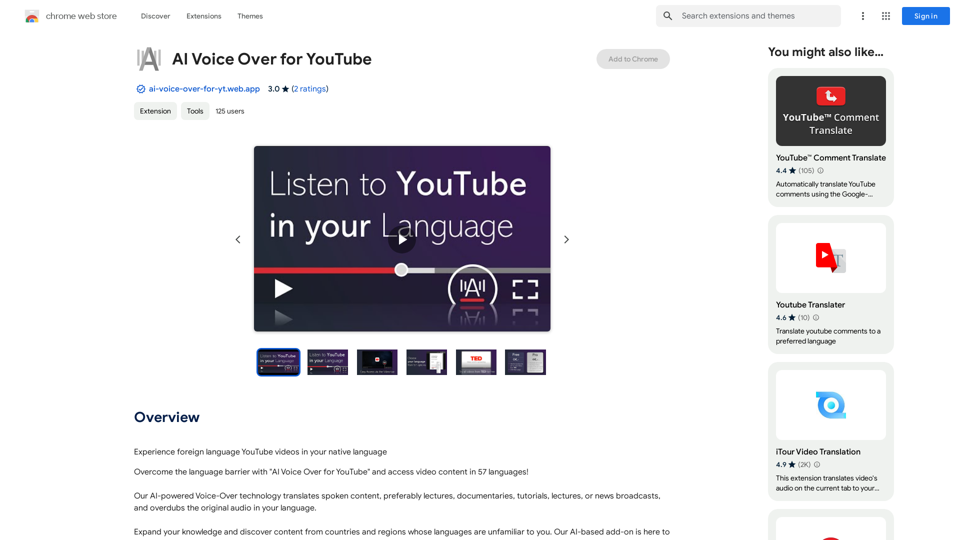
AI Voice Over for YouTube This is a guide to using AI voice over for your YouTube videos. Why Use AI Voice Over? * Cost-Effective: AI voice over is much cheaper than hiring a professional voice actor. * Time-Saving: You can generate voice over quickly and easily, without needing to schedule recording sessions. * Variety of Voices: Choose from a wide range of AI voices, including male, female, and even robotic voices. * Accessibility: Make your videos accessible to viewers who are deaf or hard of hearing by adding captions generated by AI. How to Use AI Voice Over 1. Choose a Platform: There are many different platforms that offer AI voice over services, such as: * Google Cloud Text-to-Speech * Amazon Polly * Microsoft Azure Text to Speech * Murf.ai * NaturalReader 2. Write Your Script: Write a clear and concise script for your video. 3. Upload Your Script: Upload your script to the chosen platform. 4. Select a Voice: Choose the voice that best suits your video. 5. Adjust Settings: Adjust settings such as speed, pitch, and volume. 6. Generate Voice Over: Click the "Generate" button to create your voice over. 7. Download and Edit: Download the generated voice over file and edit it as needed. 8. Add to Your Video: Add the voice over to your YouTube video. Tips for Using AI Voice Over * Use Natural Language: Write your script as if you were speaking naturally. * Vary Your Tone: Use different tones of voice to keep your viewers engaged. * Add Pauses: Include pauses in your script to allow viewers to process information. * Proofread Carefully: Always proofread your script before generating the voice over. * Experiment: Try different voices, settings, and styles to find what works best for you.
AI Voice Over for YouTube This is a guide to using AI voice over for your YouTube videos. Why Use AI Voice Over? * Cost-Effective: AI voice over is much cheaper than hiring a professional voice actor. * Time-Saving: You can generate voice over quickly and easily, without needing to schedule recording sessions. * Variety of Voices: Choose from a wide range of AI voices, including male, female, and even robotic voices. * Accessibility: Make your videos accessible to viewers who are deaf or hard of hearing by adding captions generated by AI. How to Use AI Voice Over 1. Choose a Platform: There are many different platforms that offer AI voice over services, such as: * Google Cloud Text-to-Speech * Amazon Polly * Microsoft Azure Text to Speech * Murf.ai * NaturalReader 2. Write Your Script: Write a clear and concise script for your video. 3. Upload Your Script: Upload your script to the chosen platform. 4. Select a Voice: Choose the voice that best suits your video. 5. Adjust Settings: Adjust settings such as speed, pitch, and volume. 6. Generate Voice Over: Click the "Generate" button to create your voice over. 7. Download and Edit: Download the generated voice over file and edit it as needed. 8. Add to Your Video: Add the voice over to your YouTube video. Tips for Using AI Voice Over * Use Natural Language: Write your script as if you were speaking naturally. * Vary Your Tone: Use different tones of voice to keep your viewers engaged. * Add Pauses: Include pauses in your script to allow viewers to process information. * Proofread Carefully: Always proofread your script before generating the voice over. * Experiment: Try different voices, settings, and styles to find what works best for you.Watch foreign language YouTube videos in your own language.
193.90 M
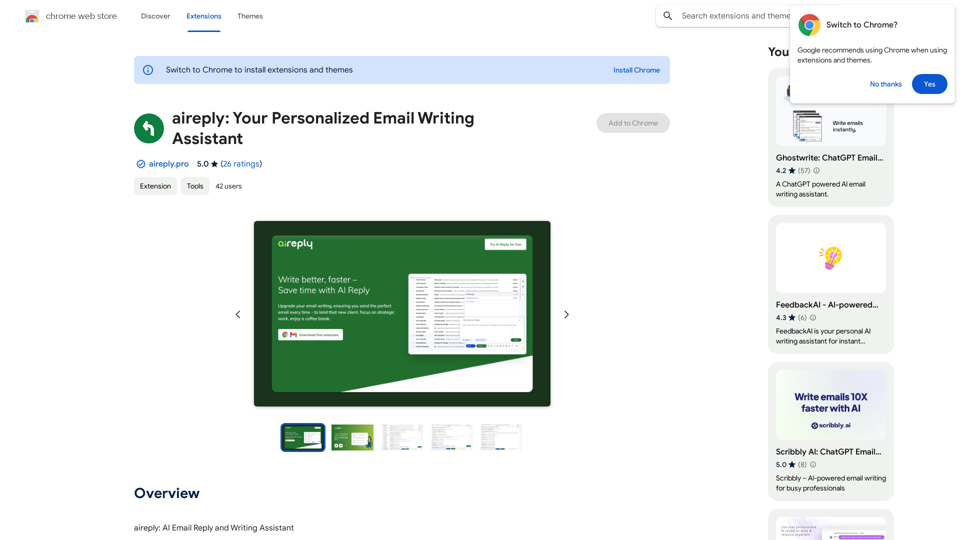
aireply: Your Personalized Email Writing Assistant
aireply: Your Personalized Email Writing AssistantAI Email Reply and Writing Assistant
193.90 M