Open-source RightAI Tools Directory
  • Discover AI
  • Submit
  • Startup
  • Blog
Open-source RightAI Tools Directory
Discover the best AI tools of 2025 with the RightAI Tools Directory!

Friend Links

AI Anime GeneratorToolsApp AI

Support

Tap4
Privacy policyTerms & ConditionsContact Us
Loading...
loading...

SayAI

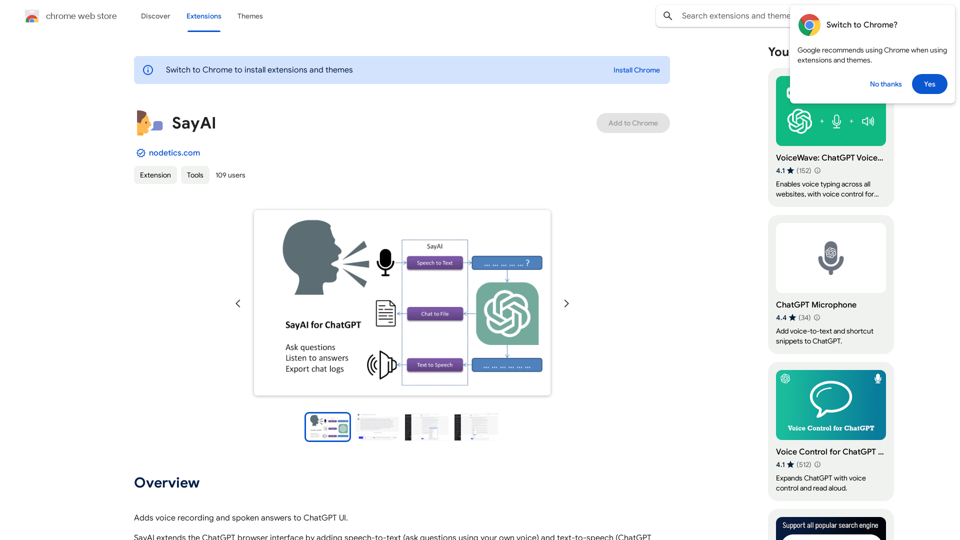
Adds voice recording and spoken answers to the ChatGPT user interface.
Visit Website
SayAI
Visit Website

Introduction

SayAI is a browser extension that enhances the ChatGPT user interface by incorporating voice recording and spoken answers. This tool allows users to interact with ChatGPT using speech-to-text for input and text-to-speech for output, making the AI conversation experience more accessible and versatile.

Feature

Voice Recording with Multi-Language Support

SayAI utilizes the OpenAI Whisper API to enable voice recording in multiple languages, allowing users to ask questions verbally in their preferred language.

Text-to-Speech Functionality

The extension leverages the speechSynthesis API and OS voice library to convert ChatGPT's text responses into spoken words, providing an auditory output option.

Customizable Voice Interaction

Users have the flexibility to enable or disable both voice recording and text-to-speech features directly within the user interface, tailoring the experience to their preferences.

Hybrid Interaction Mode

SayAI offers a unique option where users can input questions via voice but receive written responses from ChatGPT, combining the convenience of speech input with traditional text output.

Free of Charge

One of the standout features of SayAI is that it's completely free to use, making it accessible to all users without any cost barriers.

FAQ

How do I start using SayAI?

To begin using SayAI:

  1. Install the extension
  2. Restart your browser
  3. Click the SayAI icon in the browser toolbar to activate voice recording and text-to-speech
  4. Start asking questions using your voice

What languages does SayAI support?

SayAI supports 40 languages, including but not limited to English, Spanish, and French, catering to a diverse user base.

Can I customize the voice interaction settings?

Yes, you can turn voice recording and text-to-speech on or off in the user interface settings, allowing you to tailor the experience to your preferences.

Is SayAI suitable for users with visual impairments?

Absolutely. The text-to-speech feature of SayAI makes it particularly helpful for users with visual impairments, as they can listen to ChatGPT's responses instead of reading them.

Related Websites
Renaissance
View Detail

Renaissance

Renaissance

Renaissance

193.90 M
Kinky Chat - Unleash Your Fantasies
View Detail

Kinky Chat - Unleash Your Fantasies

Kinky Chat - Unleash Your Fantasies

Sign up for Kinky Chat's early access! Be the first to meet the world's most intense chatbot. Don't miss out!

17.07 K
Biolytics
View Detail

Biolytics

Biolytics

All your lab tests in one place.

527
MOJi Dictionary Plugin
View Detail

MOJi Dictionary Plugin

MOJi Dictionary Plugin

MOJi Dictionary is an official Japanese learning dictionary browser extension that makes it easy and fast to look up and save Japanese words.

193.90 M
DIDASKO BOT
View Detail

DIDASKO BOT

DIDASKO BOT

Instantaneous Responses to Modules 1-7, by Antonio Caprio [v5-6]

193.90 M
Bilibili Subtitle List
View Detail

Bilibili Subtitle List

Bilibili Subtitle List

Display a list of Bilibili video subtitles, allowing you to click to jump and download subtitles, and supporting translation and summary of subtitles!

193.90 M
DecentralizedAI 

This is a general term referring to artificial intelligence (AI) systems that are not controlled by a single, centralized entity. 

Instead of relying on a large corporation or government to manage and govern AI, decentralized AI aims to distribute these capabilities across a network of independent nodes. 

Think of it like a blockchain for AI:

* Transparency:  The decision-making processes of decentralized AI are open and visible to everyone.
* Security:  Since there's no single point of failure, it's harder for malicious actors to take control or manipulate the system.
* Resilience:  Even if some nodes go offline, the network can continue to function.
* Accessibility:  Decentralized AI can make AI technology more accessible to individuals and smaller organizations.


There are many potential applications for decentralized AI, including:

* Data privacy:  Decentralized AI can help protect user data by distributing it across multiple nodes.
* Fairness and bias mitigation:  By involving a wider range of participants in the training process, decentralized AI can help reduce bias in AI systems.
* Autonomous organizations:  Decentralized AI can be used to create self-governing organizations that operate without human intervention.


Decentralized AI is still a relatively new field, but it has the potential to revolutionize the way we develop and use AI.
View Detail

DecentralizedAI This is a general term referring to artificial intelligence (AI) systems that are not controlled by a single, centralized entity. Instead of relying on a large corporation or government to manage and govern AI, decentralized AI aims to distribute these capabilities across a network of independent nodes. Think of it like a blockchain for AI: * Transparency: The decision-making processes of decentralized AI are open and visible to everyone. * Security: Since there's no single point of failure, it's harder for malicious actors to take control or manipulate the system. * Resilience: Even if some nodes go offline, the network can continue to function. * Accessibility: Decentralized AI can make AI technology more accessible to individuals and smaller organizations. There are many potential applications for decentralized AI, including: * Data privacy: Decentralized AI can help protect user data by distributing it across multiple nodes. * Fairness and bias mitigation: By involving a wider range of participants in the training process, decentralized AI can help reduce bias in AI systems. * Autonomous organizations: Decentralized AI can be used to create self-governing organizations that operate without human intervention. Decentralized AI is still a relatively new field, but it has the potential to revolutionize the way we develop and use AI.

DecentralizedAI This is a general term referring to artificial intelligence (AI) systems that are not controlled by a single, centralized entity. Instead of relying on a large corporation or government to manage and govern AI, decentralized AI aims to distribute these capabilities across a network of independent nodes. Think of it like a blockchain for AI: * Transparency: The decision-making processes of decentralized AI are open and visible to everyone. * Security: Since there's no single point of failure, it's harder for malicious actors to take control or manipulate the system. * Resilience: Even if some nodes go offline, the network can continue to function. * Accessibility: Decentralized AI can make AI technology more accessible to individuals and smaller organizations. There are many potential applications for decentralized AI, including: * Data privacy: Decentralized AI can help protect user data by distributing it across multiple nodes. * Fairness and bias mitigation: By involving a wider range of participants in the training process, decentralized AI can help reduce bias in AI systems. * Autonomous organizations: Decentralized AI can be used to create self-governing organizations that operate without human intervention. Decentralized AI is still a relatively new field, but it has the potential to revolutionize the way we develop and use AI.

The AI Layer2 Extension for Google Chrome.

193.90 M
WiseGPT
View Detail

WiseGPT

WiseGPT

Autocomplete and personal prompts for ChatGPT.

193.90 M