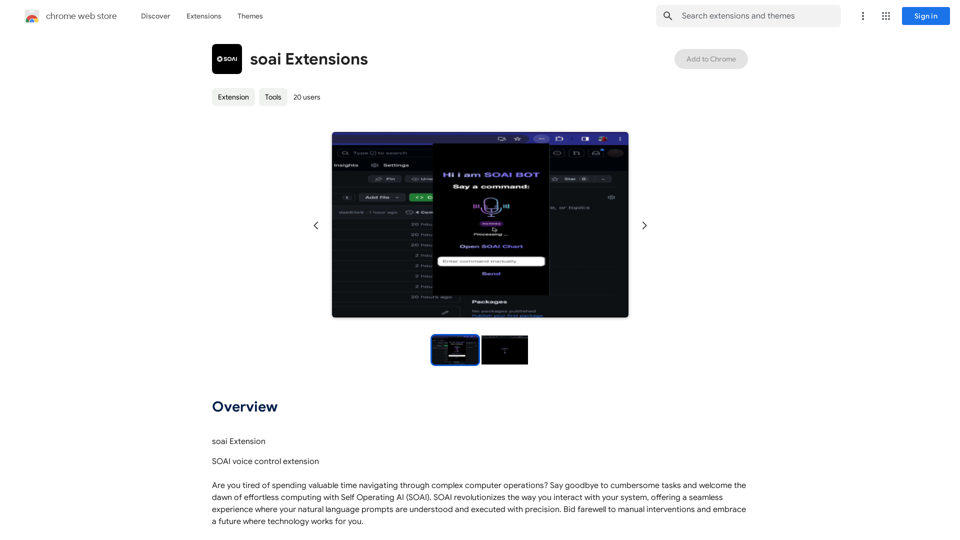
SOAI is a cutting-edge voice control extension designed to revolutionize your computing experience. It enables users to interact with their systems using natural language prompts, eliminating the need for manual interventions. SOAI offers precision execution of tasks through voice commands, providing a seamless and effortless computing experience.
SOAI empowers users to control their systems using voice commands, simplifying navigation and task execution. This feature enhances accessibility and efficiency in daily computing tasks.
Precision Execution Technology
The extension utilizes advanced technology to ensure that voice commands are executed with high precision. This eliminates the need for manual interventions, saving time and reducing errors.
Seamless User Experience
SOAI provides an uninterrupted computing experience, allowing users to focus on their tasks without distractions. The smooth integration of voice commands enhances productivity and user satisfaction.
Easy Installation and Setup
Users can easily install SOAI from the Chrome Web Store and configure it by setting up personalized voice commands and preferences. This straightforward process ensures quick adoption and customization.
Free Availability
SOAI is offered as a free extension, making it accessible to all users without any cost barriers. This allows widespread adoption of voice-controlled computing technology.
Customization Options
The extension offers customization features, allowing users to tailor their experience by setting up specific voice commands and preferences to suit their individual needs.
SOAI is designed as a Chrome extension, making it compatible with systems that support the Chrome browser. For specific system requirements, please check the extension details in the Chrome Web Store.
Can I use SOAI for complex tasks?
SOAI is capable of executing a wide range of tasks through voice commands. While it excels in common computing tasks, the complexity of tasks it can handle may depend on your setup and the specific commands you've configured.
How does SOAI ensure privacy and security?
As a voice control extension, SOAI likely processes voice commands locally or through secure channels. However, for detailed information about privacy and security measures, it's recommended to review the extension's privacy policy and documentation.
Is internet connectivity required for SOAI to function?
While basic functionality might work offline, some features of SOAI may require internet connectivity for optimal performance, especially if it utilizes cloud-based processing for voice recognition or command execution.
FatfoxTab, a new tab page, provides an all-around online experience covering gaming, office, and entertainment scenarios. With advanced language models, it's easy to get started and use, offering a vast array of websites, card-style apps, dynamic wallpapers, and a customizable user interface, all at your fingertips. It's a must-have browser plugin for building your personalized learning and working platform.
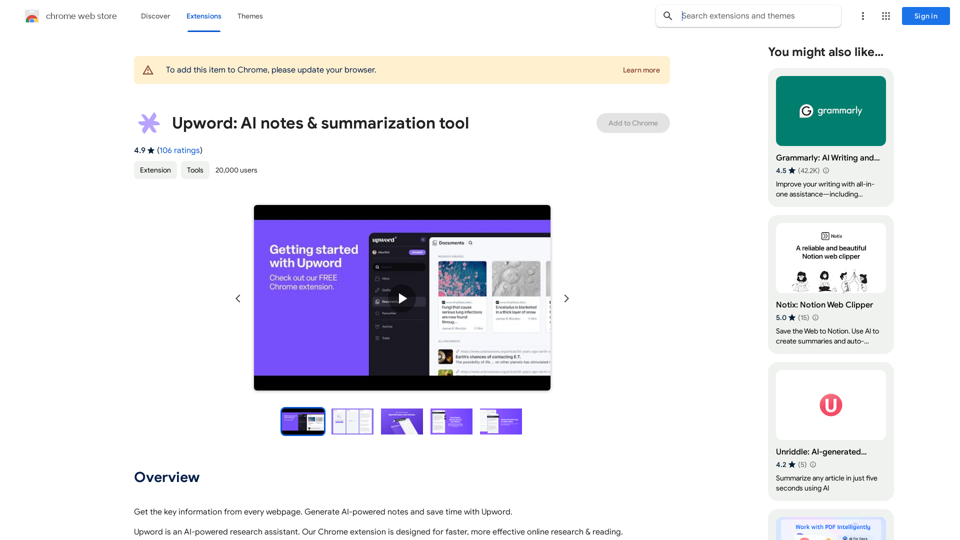
Wonder AI: The AI Writing Assistant That Makes Your Content Stand Out
Wonder AI is an AI writing assistant that uses the power of artificial intelligence to help you create high-quality, engaging content that resonates with your audience.
Slash Commands for ChatGPT and Bard
=====================================
Introduction
Slash commands are a convenient way to interact with ChatGPT and Bard, allowing you to perform various tasks and actions within the chat interface. This guide provides an overview of the available slash commands for both ChatGPT and Bard.
ChatGPT Slash Commands
#General Commands
* `/help`: Displays a list of available slash commands and their descriptions.
* `/reset`: Resets the conversation, clearing all previous messages and context.
#Conversation Management
* `/start`: Starts a new conversation, allowing you to begin a fresh topic or task.
* `/stop`: Ends the current conversation, stopping any ongoing tasks or topics.
#Language and Tone
* `/lang <language_code>`: Sets the language for the conversation (e.g., `/lang en` for English).
* `/tone <tone>`: Adjusts the tone of the responses (e.g., `/tone formal` for formal tone).
#Task Management
* `/task <task_name>`: Creates a new task or topic for the conversation (e.g., `/task math problem`).
* `/done`: Marks the current task as completed.
#Information and Resources
* `/define <word>`: Provides the definition of a word or phrase.
* `/wiki <topic>`: Displays information about a topic from Wikipedia.
Bard Slash Commands
#General Commands
* `/help`: Displays a list of available slash commands and their descriptions.
* `/reset`: Resets the conversation, clearing all previous messages and context.
#Conversation Management
* `/start`: Starts a new conversation, allowing you to begin a fresh topic or task.
* `/stop`: Ends the current conversation, stopping any ongoing tasks or topics.
#Language and Tone
* `/lang <language_code>`: Sets the language for the conversation (e.g., `/lang en` for English).
* `/tone <tone>`: Adjusts the tone of the responses (e.g., `/tone formal` for formal tone).
#Task Management
* `/task <task_name>`: Creates a new task or topic for the conversation (e.g., `/task math problem`).
* `/done`: Marks the current task as completed.
#Information and Resources
* `/define <word>`: Provides the definition of a word or phrase.
* `/wiki <topic>`: Displays information about a topic from Wikipedia.
* `/news <topic>`: Displays news articles related to a specific topic.
Conclusion
Slash commands provide a convenient way to interact with ChatGPT and Bard, allowing you to manage conversations, adjust language and tone, and access various resources. By mastering these commands, you can optimize your experience and get the most out of your interactions with these AI models.
Driven by models such as GPT-4 Turbo and GPT-4 O, this private AI work assistant supports a wide range of functions, including GPT networking, PDF analysis, GPT-4 Vision, SD drawing, and DALL·E 3 drawing, making it your most powerful AI work assistant!
Interfacing with AI
This document explores the various ways humans interact with artificial intelligence (AI).
Types of Interfaces
* Text-based Interfaces: These interfaces allow users to communicate with AI systems through written language.
* Examples include chatbots, command-line interfaces, and search engines.
* Voice-based Interfaces: Users interact with AI using spoken words.
* Examples include virtual assistants like Siri, Alexa, and Google Assistant.
* Graphical User Interfaces (GUIs): These interfaces use visual elements like icons, buttons, and menus to enable interaction with AI.
* Examples include AI-powered image editing software and virtual reality experiences.
* Gesture-based Interfaces: Users control AI systems through physical movements.
* Examples include motion-controlled gaming and sign language recognition.
Challenges of AI Interfacing
* Natural Language Understanding (NLU): AI systems struggle to fully understand the nuances of human language.
* Contextual Awareness: AI often lacks the ability to understand the broader context of a conversation or interaction.
* Personalization: Creating AI interfaces that are tailored to individual user preferences and needs can be complex.
* Ethical Considerations:
* Bias in AI algorithms can lead to unfair or discriminatory outcomes.
* Privacy concerns arise when AI systems collect and process personal data.
Future of AI Interfacing
* More Natural and Intuitive Interactions: Advancements in NLU and machine learning will lead to AI systems that can understand and respond to human input more naturally.
* Multi-modal Interfaces: Future interfaces will likely combine multiple input methods (e.g., text, voice, gesture) for a richer and more immersive experience.
* Personalized AI Assistants: AI assistants will become increasingly personalized, anticipating user needs and providing customized support.
* Ethical AI Development:
* Researchers and developers will continue to work on mitigating bias and ensuring responsible use of AI.