Open-source RightAI Tools Directory
  • Discover AI
  • Submit
  • Startup
  • Blog
Open-source RightAI Tools Directory
Discover the best AI tools of 2025 with the RightAI Tools Directory!

Friend Links

AI Anime GeneratorToolsApp AI

Support

Tap4
Privacy policyTerms & ConditionsContact Us
Loading...
loading...

AI Describe Picture & Image | Free AI-generated image description

AI picture & image description generator, helping you quickly generate image descriptions.
Visit Website
AI Describe Picture & Image | Free AI-generated image description
Visit Website

Introduction

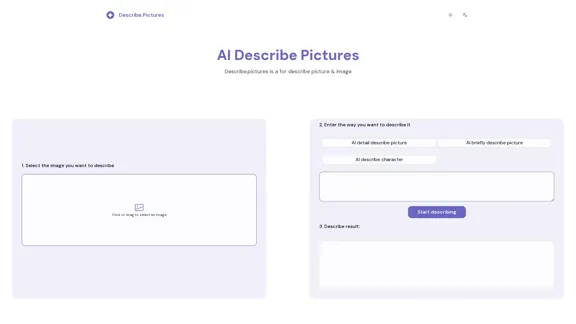
Describe.pictures is an AI-powered tool designed to generate detailed descriptions of images. It offers users the ability to quickly obtain comprehensive or brief descriptions of uploaded pictures, making it useful for various applications such as content creation, accessibility, and image analysis.

Feature

Image Upload

Users can easily upload images by clicking or dragging and dropping files onto the platform.

Multiple Description Options

The tool provides various description modes:

  • AI detail describe picture
  • AI briefly describe picture
  • AI describe character
  • Customizable description methods

Instant Results

After selecting an image and choosing a description method, users can quickly obtain AI-generated descriptions.

Versatile Applications

Describe.pictures can be used for:

  • Enhancing accessibility for visually impaired users
  • Generating content for social media posts
  • Analyzing images for research or creative purposes
  • Assisting in SEO by providing detailed image descriptions

User-Friendly Interface

The platform offers a simple three-step process:

  1. Select an image
  2. Choose a description method
  3. View the generated description

Examples Provided

The website showcases example descriptions, including a detailed analysis of an F1 racing scene and a brief description of a moon landing photograph.

FAQ

What is Describe.pictures?

Describe.pictures is an AI-powered tool that generates detailed or brief descriptions of uploaded images, helping users quickly obtain comprehensive information about visual content.

How does Describe.pictures work?

The tool uses AI large models to analyze uploaded images and generate descriptions based on the user's chosen method (detailed, brief, or character-focused).

Can I customize the description method?

Yes, Describe.pictures allows users to choose from predefined description methods or customize their own approach for more specific results.

Is Describe.pictures free to use?

While the website mentions it's a "Free ai generate image description" tool, it's best to check their terms of service or pricing page for the most up-to-date information on any potential costs or usage limits.

What types of images can I describe using this tool?

The tool appears to be versatile, capable of describing various types of images, from complex scenes like F1 races to historic photographs like the moon landing. It's likely suitable for a wide range of image types and subjects.

Latest Traffic Insights

  • Monthly Visits

    7.04 K

  • Bounce Rate

    44.79%

  • Pages Per Visit

    1.37

  • Time on Site(s)

    4.91

  • Global Rank

    3069707

  • Country Rank

    United States 2046422

Recent Visits

Traffic Sources

  • Social Media:
    13.34%
  • Paid Referrals:
    0.86%
  • Email:
    0.19%
  • Referrals:
    5.64%
  • Search Engines:
    47.98%
  • Direct:
    31.90%
More Data

Related Websites

Text to Voice Generator
==========================

A text-to-voice generator, also known as a text-to-speech (TTS) system, is a software that converts written text into a spoken voice output. This technology has been widely used in various applications, including virtual assistants, audiobooks, and language learning platforms.

How it Works
---------------

The process of generating voice from text involves several steps:

1. Text Analysis: The input text is analyzed to identify the language, syntax, and semantics.
2. Phonetic Transcription: The text is converted into a phonetic transcription, which represents the sounds of the spoken language.
3. Prosody Generation: The phonetic transcription is then used to generate the prosody, or rhythm and intonation, of the spoken voice.
4. Waveform Generation: The prosody and phonetic transcription are combined to generate the audio waveform, which is the final spoken voice output.

Types of Text-to-Voice Generators
-----------------------------------

There are two main types of text-to-voice generators:

Rule-Based Systems

These systems use a set of predefined rules to generate the spoken voice output. They are often limited in their ability to produce natural-sounding voices and may sound robotic.

Machine Learning-Based Systems

These systems use machine learning algorithms to learn from large datasets of spoken voices and generate more natural-sounding voices. They are often more advanced and can produce high-quality voice outputs.

Applications of Text-to-Voice Generators
-----------------------------------------

Text-to-voice generators have a wide range of applications, including:

Virtual Assistants

Virtual assistants, such as Siri and Alexa, use text-to-voice generators to respond to user queries.

Audiobooks

Text-to-voice generators can be used to create audiobooks from written texts, making it easier for people to access written content.

Language Learning

Language learning platforms use text-to-voice generators to provide pronunciation guidance and practice exercises for learners.

Accessibility

Text-to-voice generators can be used to assist people with disabilities, such as visual impairments, by providing an auditory interface to written content.
View Detail

Text to Voice Generator ========================== A text-to-voice generator, also known as a text-to-speech (TTS) system, is a software that converts written text into a spoken voice output. This technology has been widely used in various applications, including virtual assistants, audiobooks, and language learning platforms. How it Works --------------- The process of generating voice from text involves several steps: 1. Text Analysis: The input text is analyzed to identify the language, syntax, and semantics. 2. Phonetic Transcription: The text is converted into a phonetic transcription, which represents the sounds of the spoken language. 3. Prosody Generation: The phonetic transcription is then used to generate the prosody, or rhythm and intonation, of the spoken voice. 4. Waveform Generation: The prosody and phonetic transcription are combined to generate the audio waveform, which is the final spoken voice output. Types of Text-to-Voice Generators ----------------------------------- There are two main types of text-to-voice generators: Rule-Based Systems These systems use a set of predefined rules to generate the spoken voice output. They are often limited in their ability to produce natural-sounding voices and may sound robotic. Machine Learning-Based Systems These systems use machine learning algorithms to learn from large datasets of spoken voices and generate more natural-sounding voices. They are often more advanced and can produce high-quality voice outputs. Applications of Text-to-Voice Generators ----------------------------------------- Text-to-voice generators have a wide range of applications, including: Virtual Assistants Virtual assistants, such as Siri and Alexa, use text-to-voice generators to respond to user queries. Audiobooks Text-to-voice generators can be used to create audiobooks from written texts, making it easier for people to access written content. Language Learning Language learning platforms use text-to-voice generators to provide pronunciation guidance and practice exercises for learners. Accessibility Text-to-voice generators can be used to assist people with disabilities, such as visual impairments, by providing an auditory interface to written content.

Text to Voice Generator ========================== A text-to-voice generator, also known as a text-to-speech (TTS) system, is a software that converts written text into a spoken voice output. This technology has been widely used in various applications, including virtual assistants, audiobooks, and language learning platforms. How it Works --------------- The process of generating voice from text involves several steps: 1. Text Analysis: The input text is analyzed to identify the language, syntax, and semantics. 2. Phonetic Transcription: The text is converted into a phonetic transcription, which represents the sounds of the spoken language. 3. Prosody Generation: The phonetic transcription is then used to generate the prosody, or rhythm and intonation, of the spoken voice. 4. Waveform Generation: The prosody and phonetic transcription are combined to generate the audio waveform, which is the final spoken voice output. Types of Text-to-Voice Generators ----------------------------------- There are two main types of text-to-voice generators: Rule-Based Systems These systems use a set of predefined rules to generate the spoken voice output. They are often limited in their ability to produce natural-sounding voices and may sound robotic. Machine Learning-Based Systems These systems use machine learning algorithms to learn from large datasets of spoken voices and generate more natural-sounding voices. They are often more advanced and can produce high-quality voice outputs. Applications of Text-to-Voice Generators ----------------------------------------- Text-to-voice generators have a wide range of applications, including: Virtual Assistants Virtual assistants, such as Siri and Alexa, use text-to-voice generators to respond to user queries. Audiobooks Text-to-voice generators can be used to create audiobooks from written texts, making it easier for people to access written content. Language Learning Language learning platforms use text-to-voice generators to provide pronunciation guidance and practice exercises for learners. Accessibility Text-to-voice generators can be used to assist people with disabilities, such as visual impairments, by providing an auditory interface to written content.

Generate Voice from Text on Any Web Page With the advancement of technology, it is now possible to generate voice from text on any web page. This feature is particularly useful for people who prefer listening to content rather than reading it. Here's how you can do it: #Method 1: Using Browser Extension You can use a browser extension like Read Aloud or SpeakIt! to generate voice from text on any web page. These extensions are available for both Google Chrome and Mozilla Firefox browsers. #Method 2: Using Online Tools There are several online tools available that can convert text to speech. Some popular tools include NaturalReader, Voice Dream Reader, and Google Text-to-Speech. You can copy and paste the text from any web page into these tools to generate voice. #Method 3: Using Screen Reader If you are using a Windows operating system, you can use the built-in Narrator screen reader to generate voice from text on any web page. For Mac users, you can use VoiceOver. By using any of these methods, you can easily generate voice from text on any web page and enjoy a more convenient and accessible reading experience.

193.90 M
Komiko | Create Comics and Webtoons with AI
View Detail

Komiko | Create Comics and Webtoons with AI

Komiko | Create Comics and Webtoons with AI

Bring your stories to life with AI. Create captivating comics, webtoon, and visual stories. Design original characters and dive into limitless story worlds.

743.50 K
Brush - Smart and Easy Image Editing App
View Detail

Brush - Smart and Easy Image Editing App

Brush - Smart and Easy Image Editing App

Transform your photos effortlessly with Pincel, the intelligent and user-friendly online image editing application. Perfect your images, one brush stroke at a time.

562.68 K
YouTube Summary AI with Gemini

Gemini, Google's powerful new AI, is making waves in the world of YouTube. 

Imagine a future where YouTube videos automatically generate concise and informative summaries. That's exactly what Gemini aims to achieve.

By leveraging its advanced language understanding capabilities, Gemini can analyze video content and extract key points, creating summaries that capture the essence of the video. 

This means viewers can quickly grasp the main ideas without having to watch the entire video.

Gemini's potential applications extend beyond simple summaries. It could also be used to:

* Generate captions:  Automatically create accurate captions for videos, making them accessible to a wider audience.
* Translate videos:  Break down language barriers by translating videos into different languages.
* Create interactive experiences:  Enable viewers to engage with videos in new and innovative ways through interactive summaries and quizzes.


Gemini's arrival on YouTube promises to revolutionize the way we consume and interact with video content.
View Detail

YouTube Summary AI with Gemini Gemini, Google's powerful new AI, is making waves in the world of YouTube. Imagine a future where YouTube videos automatically generate concise and informative summaries. That's exactly what Gemini aims to achieve. By leveraging its advanced language understanding capabilities, Gemini can analyze video content and extract key points, creating summaries that capture the essence of the video. This means viewers can quickly grasp the main ideas without having to watch the entire video. Gemini's potential applications extend beyond simple summaries. It could also be used to: * Generate captions: Automatically create accurate captions for videos, making them accessible to a wider audience. * Translate videos: Break down language barriers by translating videos into different languages. * Create interactive experiences: Enable viewers to engage with videos in new and innovative ways through interactive summaries and quizzes. Gemini's arrival on YouTube promises to revolutionize the way we consume and interact with video content.

YouTube Summary AI with Gemini Gemini, Google's powerful new AI, is making waves in the world of YouTube. Imagine a future where YouTube videos automatically generate concise and informative summaries. That's exactly what Gemini aims to achieve. By leveraging its advanced language understanding capabilities, Gemini can analyze video content and extract key points, creating summaries that capture the essence of the video. This means viewers can quickly grasp the main ideas without having to watch the entire video. Gemini's potential applications extend beyond simple summaries. It could also be used to: * Generate captions: Automatically create accurate captions for videos, making them accessible to a wider audience. * Translate videos: Break down language barriers by translating videos into different languages. * Create interactive experiences: Enable viewers to engage with videos in new and innovative ways through interactive summaries and quizzes. Gemini's arrival on YouTube promises to revolutionize the way we consume and interact with video content.

AI tool powered by Gemini that summarizes YouTube videos.

193.90 M
Torii Image Translator — Use GPT-4 & DeepL to Translate Any Image, Manga...
View Detail

Torii Image Translator — Use GPT-4 & DeepL to Translate Any Image, Manga...

Torii Image Translator — Use GPT-4 & DeepL to Translate Any Image, Manga...

Translate any image on any website into any language! Perfect for Manga, Manhwa, Manhua, Comics, ArtistCG, Memes, or any image at all!

193.90 M
Photoleap - Creative & powerful photo editing app by Lightricks
View Detail

Photoleap - Creative & powerful photo editing app by Lightricks

Photoleap - Creative & powerful photo editing app by Lightricks

Use the comprehensive photo editor Photoleap for incredible creations on your iPhone: Alter backgrounds, eliminate objects, design collages, and apply filters & effects. Start a 7-day free trial now.

196.20 K
Odyssey: Imagine. Create. Automate.
View Detail

Odyssey: Imagine. Create. Automate.

Odyssey: Imagine. Create. Automate.

Odyssey is a native Mac app for creating remarkable art, getting work done, and automating repetitive tasks with the power of AI.

12.13 K
DreamStudio
View Detail

DreamStudio

DreamStudio

DreamStudio is an AI-powered image generation platform developed by Stability AI

8.59 K