Open-source RightAI Tools Directory
  • Discover AI
  • Submit
  • Startup
  • Blog
Open-source RightAI Tools Directory
Discover the best AI tools of 2025 with the RightAI Tools Directory!

Friend Links

AI Anime GeneratorToolsApp AI

Support

Tap4
Privacy policyTerms & ConditionsContact Us
Loading...
loading...

Home - Marketing Automation

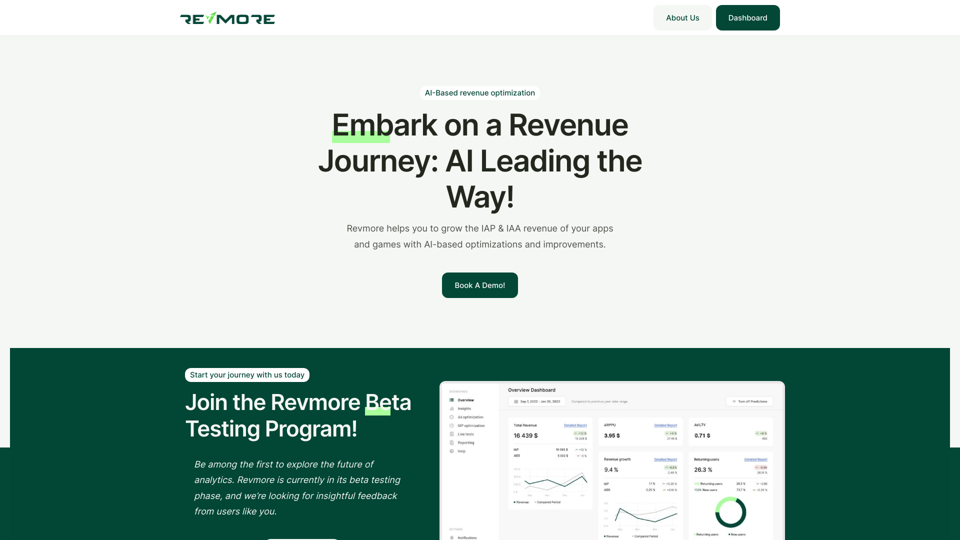
AI-Based Revenue Optimization Embark on a Revenue Journey: AI Leading the Way! Revmore helps you to grow the in-app purchase (IAP) and in-app advertising (IAA) revenue of your apps and games with AI-based optimizations and improvements. Book A Demo! Elevate your revenue with our AI magic. Explore our diverse optimization solutions, meticulously crafted to meet unique demands. In-app Purchase (IAP)
Visit Website
Home - Marketing Automation
Visit Website

Introduction

Revmore is an AI-powered platform designed to optimize and enhance app and game monetization strategies. It focuses on increasing In-App Purchase (IAP) and In-App Advertising (IAA) revenue through advanced AI-based solutions. Revmore's key strengths lie in its ability to provide customized package offerings, conduct ad interval AB tests, and optimize SKU pricing, all while seamlessly integrating with existing tech stacks.

Feature

Customized Package Offering

Revmore's AI analyzes historical data and uses machine learning to suggest optimal packages tailored to your audience, maximizing revenue potential across all channels.

Ad Interval AB Testing

The platform ensures continuous AB testing to determine the most effective times and placements for ads, helping to maximize ad revenue without compromising user experience.

SKU Price Optimization

Leveraging AI-driven data analysis, machine learning, and user attribution, Revmore identifies the most efficient pricing strategies for your products, presenting end users with the best offers.

Multi-Platform SDK Integration

Revmore offers a versatile SDK compatible with all major technologies, facilitating easy integration into existing tech stacks for seamless revenue optimization.

Data-Driven Insights

The platform provides valuable insights based on AI analysis, helping developers make informed decisions about monetization strategies and user engagement.

Flexible Pricing Options

Revmore offers various pricing plans to accommodate different needs and budgets, ensuring accessibility for a wide range of app and game developers.

FAQ

How does Revmore work?

Revmore utilizes AI-driven algorithms to analyze app and game data, providing personalized recommendations for optimization and improvement of monetization strategies.

Is Revmore compatible with existing tech stacks?

Yes, Revmore's multi-platform SDK is designed to be compatible with all notable technologies, ensuring easy and seamless integration with existing systems.

How can I get started with Revmore?

To begin using Revmore, you can contact their team to schedule a demo and learn more about how the platform can help elevate your app or game revenue.

What types of optimization does Revmore offer?

Revmore offers various optimization features, including customized package offerings, ad interval AB testing, and SKU price optimization, all powered by AI and machine learning technologies.

Are there any tips for maximizing the benefits of Revmore?

To maximize Revmore's benefits:

  1. Clearly define your target audience and their preferences
  2. Regularly monitor ad performance to optimize design and intervals
  3. Experiment with different pricing strategies to find the most effective approach for your products

Latest Traffic Insights

  • Monthly Visits

    0

  • Bounce Rate

    0.00%

  • Pages Per Visit

    0.00

  • Time on Site(s)

    0.00

  • Global Rank

    -

  • Country Rank

    -

Recent Visits

Traffic Sources

  • Social Media:
    0.00%
  • Paid Referrals:
    0.00%
  • Email:
    0.00%
  • Referrals:
    0.00%
  • Search Engines:
    0.00%
  • Direct:
    0.00%
More Data

Related Websites

AI Art Generator | AI Image Generator - Jasper Art
View Detail

AI Art Generator | AI Image Generator - Jasper Art

AI Art Generator | AI Image Generator - Jasper Art

Jasper Art is a new AI art generator that transforms your text prompt into stunning art and lifelike AI-generated images within seconds. Your AI artist produces the ideal picture to complement your message.

939.36 K
The "Local Art" on the App Store
View Detail

The "Local Art" on the App Store

The "Local Art" on the App Store

Experience the power of local AI art generation with our innovative iOS app. By utilizing your local computer's GPU through API proxy, you can create stunning AI-generated artwork without relying on cloud services, ensuring faster processing speeds and greater control over your creative vision.

124.77 M
AI Photo Editor - Edit photos online for free
View Detail

AI Photo Editor - Edit photos online for free

AI Photo Editor - Edit photos online for free

Pixelfox AI is one of the best free AI image editing tools, designed to automatically edit images and photos. Start editing photos now.

58.05 K
ArtiverseHub - AI Art Generator
View Detail

ArtiverseHub - AI Art Generator

ArtiverseHub - AI Art Generator

Unleash your creativity with ArtiverseHub's online AI art generator. Enjoy support for multiple platforms including DALL-E (ChatGPT), Leonardo.ai, Stability.ai, and several others.

823
Toggle Terminal – Bring data to life with natural language
View Detail

Toggle Terminal – Bring data to life with natural language

Toggle Terminal – Bring data to life with natural language

Bid farewell to outdated terminals and cumbersome, antiquated interfaces. Our institutional-grade analytical tools spring into action, ready to serve you, simply by asking questions in everyday language.

0
Framedrop.ai: Convert Video to Shorts
View Detail

Framedrop.ai: Convert Video to Shorts

Framedrop.ai: Convert Video to Shorts

Get and share highlights from YouTube and Twitch.

193.90 M
Text to Voice Generator
==========================

A text-to-voice generator, also known as a text-to-speech (TTS) system, is a software that converts written text into a spoken voice output. This technology has been widely used in various applications, including virtual assistants, audiobooks, and language learning platforms.

How it Works
---------------

The process of generating voice from text involves several steps:

1. Text Analysis: The input text is analyzed to identify the language, syntax, and semantics.
2. Phonetic Transcription: The text is converted into a phonetic transcription, which represents the sounds of the spoken language.
3. Prosody Generation: The phonetic transcription is then used to generate the prosody, or rhythm and intonation, of the spoken voice.
4. Waveform Generation: The prosody and phonetic transcription are combined to generate the audio waveform, which is the final spoken voice output.

Types of Text-to-Voice Generators
-----------------------------------

There are two main types of text-to-voice generators:

Rule-Based Systems

These systems use a set of predefined rules to generate the spoken voice output. They are often limited in their ability to produce natural-sounding voices and may sound robotic.

Machine Learning-Based Systems

These systems use machine learning algorithms to learn from large datasets of spoken voices and generate more natural-sounding voices. They are often more advanced and can produce high-quality voice outputs.

Applications of Text-to-Voice Generators
-----------------------------------------

Text-to-voice generators have a wide range of applications, including:

Virtual Assistants

Virtual assistants, such as Siri and Alexa, use text-to-voice generators to respond to user queries.

Audiobooks

Text-to-voice generators can be used to create audiobooks from written texts, making it easier for people to access written content.

Language Learning

Language learning platforms use text-to-voice generators to provide pronunciation guidance and practice exercises for learners.

Accessibility

Text-to-voice generators can be used to assist people with disabilities, such as visual impairments, by providing an auditory interface to written content.
View Detail

Text to Voice Generator ========================== A text-to-voice generator, also known as a text-to-speech (TTS) system, is a software that converts written text into a spoken voice output. This technology has been widely used in various applications, including virtual assistants, audiobooks, and language learning platforms. How it Works --------------- The process of generating voice from text involves several steps: 1. Text Analysis: The input text is analyzed to identify the language, syntax, and semantics. 2. Phonetic Transcription: The text is converted into a phonetic transcription, which represents the sounds of the spoken language. 3. Prosody Generation: The phonetic transcription is then used to generate the prosody, or rhythm and intonation, of the spoken voice. 4. Waveform Generation: The prosody and phonetic transcription are combined to generate the audio waveform, which is the final spoken voice output. Types of Text-to-Voice Generators ----------------------------------- There are two main types of text-to-voice generators: Rule-Based Systems These systems use a set of predefined rules to generate the spoken voice output. They are often limited in their ability to produce natural-sounding voices and may sound robotic. Machine Learning-Based Systems These systems use machine learning algorithms to learn from large datasets of spoken voices and generate more natural-sounding voices. They are often more advanced and can produce high-quality voice outputs. Applications of Text-to-Voice Generators ----------------------------------------- Text-to-voice generators have a wide range of applications, including: Virtual Assistants Virtual assistants, such as Siri and Alexa, use text-to-voice generators to respond to user queries. Audiobooks Text-to-voice generators can be used to create audiobooks from written texts, making it easier for people to access written content. Language Learning Language learning platforms use text-to-voice generators to provide pronunciation guidance and practice exercises for learners. Accessibility Text-to-voice generators can be used to assist people with disabilities, such as visual impairments, by providing an auditory interface to written content.

Text to Voice Generator ========================== A text-to-voice generator, also known as a text-to-speech (TTS) system, is a software that converts written text into a spoken voice output. This technology has been widely used in various applications, including virtual assistants, audiobooks, and language learning platforms. How it Works --------------- The process of generating voice from text involves several steps: 1. Text Analysis: The input text is analyzed to identify the language, syntax, and semantics. 2. Phonetic Transcription: The text is converted into a phonetic transcription, which represents the sounds of the spoken language. 3. Prosody Generation: The phonetic transcription is then used to generate the prosody, or rhythm and intonation, of the spoken voice. 4. Waveform Generation: The prosody and phonetic transcription are combined to generate the audio waveform, which is the final spoken voice output. Types of Text-to-Voice Generators ----------------------------------- There are two main types of text-to-voice generators: Rule-Based Systems These systems use a set of predefined rules to generate the spoken voice output. They are often limited in their ability to produce natural-sounding voices and may sound robotic. Machine Learning-Based Systems These systems use machine learning algorithms to learn from large datasets of spoken voices and generate more natural-sounding voices. They are often more advanced and can produce high-quality voice outputs. Applications of Text-to-Voice Generators ----------------------------------------- Text-to-voice generators have a wide range of applications, including: Virtual Assistants Virtual assistants, such as Siri and Alexa, use text-to-voice generators to respond to user queries. Audiobooks Text-to-voice generators can be used to create audiobooks from written texts, making it easier for people to access written content. Language Learning Language learning platforms use text-to-voice generators to provide pronunciation guidance and practice exercises for learners. Accessibility Text-to-voice generators can be used to assist people with disabilities, such as visual impairments, by providing an auditory interface to written content.

Generate Voice from Text on Any Web Page With the advancement of technology, it is now possible to generate voice from text on any web page. This feature is particularly useful for people who prefer listening to content rather than reading it. Here's how you can do it: #Method 1: Using Browser Extension You can use a browser extension like Read Aloud or SpeakIt! to generate voice from text on any web page. These extensions are available for both Google Chrome and Mozilla Firefox browsers. #Method 2: Using Online Tools There are several online tools available that can convert text to speech. Some popular tools include NaturalReader, Voice Dream Reader, and Google Text-to-Speech. You can copy and paste the text from any web page into these tools to generate voice. #Method 3: Using Screen Reader If you are using a Windows operating system, you can use the built-in Narrator screen reader to generate voice from text on any web page. For Mac users, you can use VoiceOver. By using any of these methods, you can easily generate voice from text on any web page and enjoy a more convenient and accessible reading experience.

193.90 M
Stability AI
View Detail

Stability AI

Stability AI

Activating humanity's potential through generative AI. Open models in every modality, for everyone, everywhere.

734.70 K