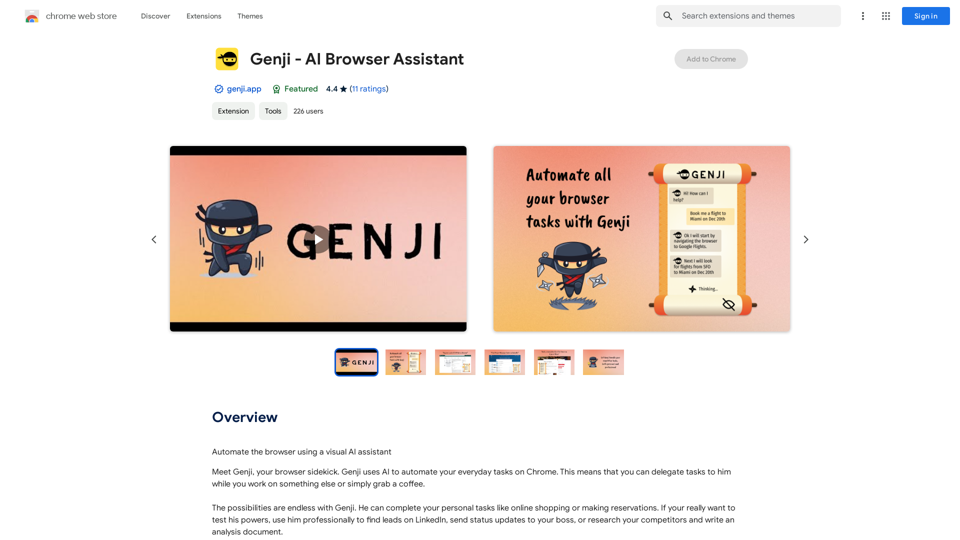
Genji is an AI-powered browser assistant for Chrome that automates everyday tasks. It allows users to delegate various tasks while they focus on other work or take a break. Genji can handle personal tasks like online shopping and making reservations, as well as professional tasks such as finding leads on LinkedIn, sending status updates, and conducting competitor research. With its ability to understand plain language commands and perform multiple tasks simultaneously, Genji aims to revolutionize browsing and boost productivity.
Genji - AI Browser Assistant
Automate the Browser Using a Visual AI Assistant
Introduction
Feature
AI-Powered Task Automation
Genji uses advanced AI technology to automate various tasks on the Chrome browser. Users can input tasks in plain language, and Genji will interpret and execute the necessary browser actions until the task is completed.
Multi-Tasking Capabilities
Genji can handle multiple tasks simultaneously, acting as an army of helpful ninjas at your service. This feature allows users to maximize their productivity by delegating various tasks to Genji at once.
Visual AI Assistant
The extension provides a visual AI assistant interface, making it easy for users to interact with and monitor the progress of their automated tasks.
Versatile Task Handling
Genji can perform a wide range of tasks, including:
- Personal tasks: Online shopping, making reservations
- Professional tasks: Finding leads on LinkedIn, sending status updates, researching competitors
Upcoming Features
- Scheduled tasks
- Voice command support
Free to Use
Users can download and start using Genji for free, making it accessible to anyone looking to enhance their browsing experience and productivity.
Privacy and Security
Genji prioritizes user data safety and privacy, implementing advanced security protocols to ensure data protection and encryption.
FAQ
How does Genji work?
Genji utilizes AI to automate everyday tasks on Chrome. Users input their tasks in plain language, and Genji deduces the necessary browser actions, repeating them until the task is complete.
What are the benefits of using Genji?
- Revolutionizes browsing experience
- Designed to make users 10x more productive on their browser
- Prioritizes data safety and privacy with advanced security protocols
How can I get started with Genji?
To get started with Genji:
- Download the Chrome extension for free
- Visit https://www.genji.app for more information
Are there any tips for using Genji effectively?
- Be specific with your queries for better understanding
- Use Genji to automate repetitive tasks
- Experiment with different tasks to explore Genji's capabilities
Is Genji safe to use?
Yes, Genji prioritizes the safety and privacy of user data, implementing advanced security protocols to ensure data protection and encryption.
Related Websites
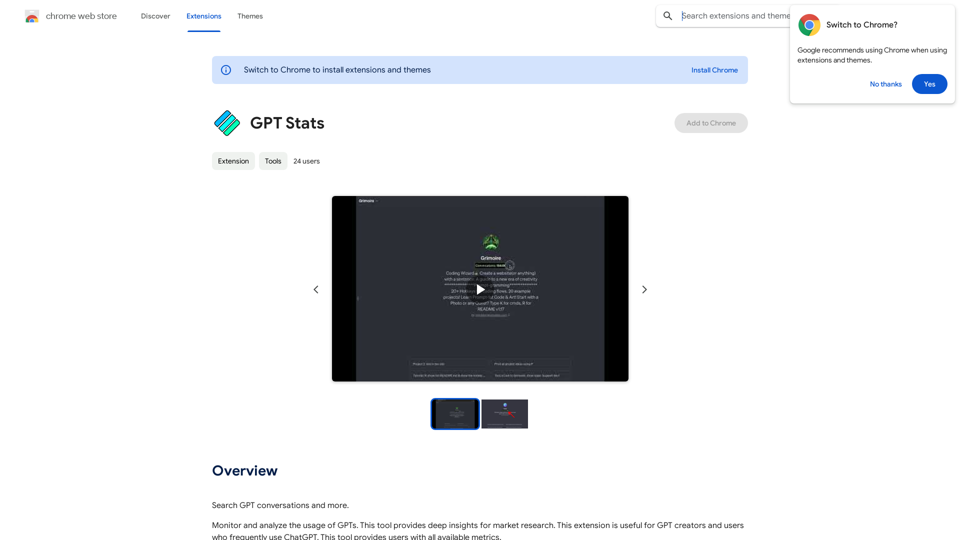
GPT Stats * Parameters: 175 Billion * Trainers: * Dataset: Massive dataset of text and code * Method: Supervised fine-tuning * Capabilities: * Text Generation * Text Summarization * Language Translation * Code Generation * Question Answering * Dialogue Generation * Limitations: * Can sometimes generate incorrect or biased information * Lacks real-world knowledge and common sense * Can be fooled by adversarial examples
GPT Stats * Parameters: 175 Billion * Trainers: * Dataset: Massive dataset of text and code * Method: Supervised fine-tuning * Capabilities: * Text Generation * Text Summarization * Language Translation * Code Generation * Question Answering * Dialogue Generation * Limitations: * Can sometimes generate incorrect or biased information * Lacks real-world knowledge and common sense * Can be fooled by adversarial examplesSearch for conversations with GPT and other content.
193.90 M

Signify - Compliance Management System for Manufacturing
Signify - Compliance Management System for ManufacturingSignify automates compliance for manufacturers by analyzing documents to ensure regulatory requirements are met throughout the product lifecycle.
3.17 K

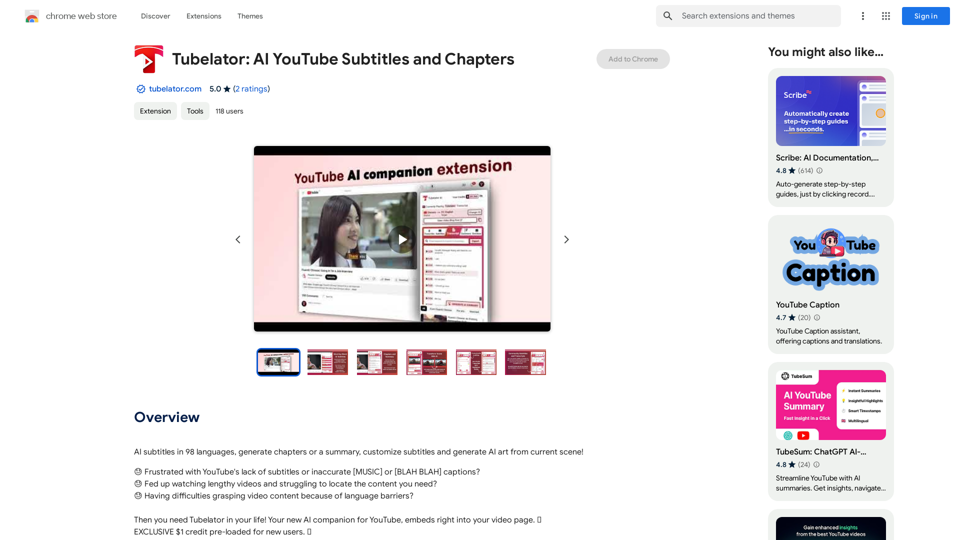
AI subtitles in 98 languages, generate chapters or a summary, customize subtitles and generate AI art from the current scene!
193.90 M

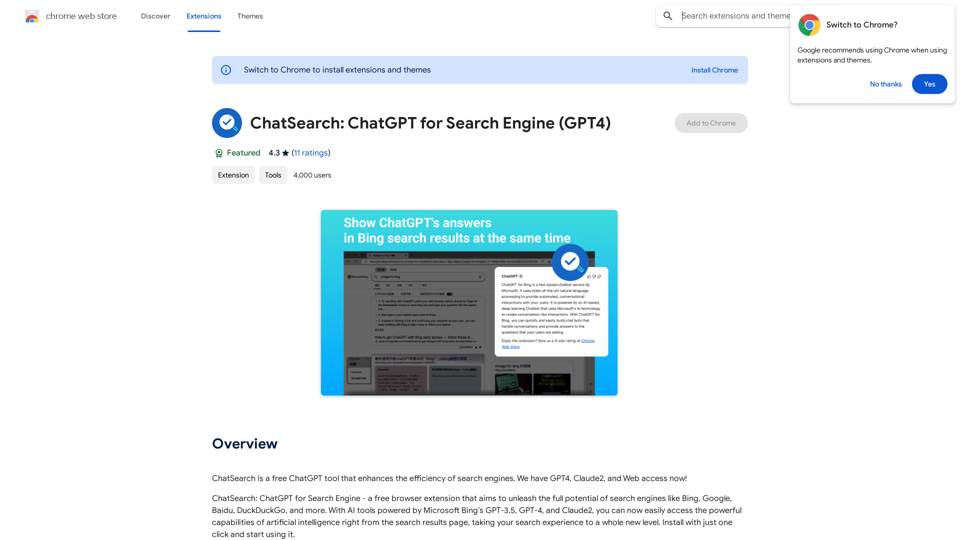
ChatSearch is a free ChatGPT tool that makes search engines more efficient. It now has GPT4, Claude2, and access to the web!
193.90 M
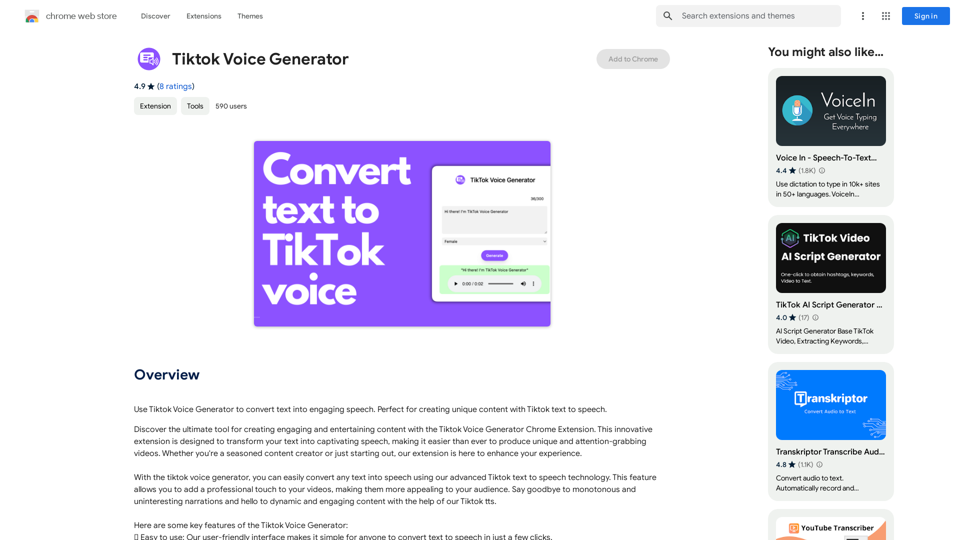
TikTok Voice Generator ========================== The TikTok voice generator is a popular feature on the social media platform that allows users to create and share videos with unique and entertaining voiceovers. This feature has become a sensation among TikTok users, with many using it to add humor, creativity, and personality to their videos. How Does it Work? -------------------- The TikTok voice generator uses advanced AI technology to convert written text into a spoken voice. Users can type in the text they want to convert, and the generator will produce a natural-sounding voiceover in a matter of seconds. The voice generator offers a range of voices, accents, and languages to choose from, allowing users to customize their voiceovers to fit their style and preferences. Features and Benefits ------------------------- Variety of Voices The TikTok voice generator offers a vast library of voices, including male and female voices, different accents, and languages. This allows users to experiment with different voices and find the one that best suits their content. Easy to Use The voice generator is incredibly easy to use. Users simply need to type in the text they want to convert, select the voice they want to use, and the generator will do the rest. Add Humor and Creativity The TikTok voice generator is a great way to add humor and creativity to videos. Users can use the generator to create funny voiceovers, parody songs, or even create their own characters. Increase Engagement Videos with voiceovers generated by the TikTok voice generator tend to perform better in terms of engagement. The unique and entertaining voiceovers can help capture viewers' attention and increase the chances of going viral. Conclusion ---------- The TikTok voice generator is a powerful tool that can help users take their content to the next level. With its advanced AI technology, ease of use, and variety of voices, it's no wonder why it has become a favorite among TikTok users. Whether you're looking to add humor, creativity, or personality to your videos, the TikTok voice generator is definitely worth trying out.
TikTok Voice Generator ========================== The TikTok voice generator is a popular feature on the social media platform that allows users to create and share videos with unique and entertaining voiceovers. This feature has become a sensation among TikTok users, with many using it to add humor, creativity, and personality to their videos. How Does it Work? -------------------- The TikTok voice generator uses advanced AI technology to convert written text into a spoken voice. Users can type in the text they want to convert, and the generator will produce a natural-sounding voiceover in a matter of seconds. The voice generator offers a range of voices, accents, and languages to choose from, allowing users to customize their voiceovers to fit their style and preferences. Features and Benefits ------------------------- Variety of Voices The TikTok voice generator offers a vast library of voices, including male and female voices, different accents, and languages. This allows users to experiment with different voices and find the one that best suits their content. Easy to Use The voice generator is incredibly easy to use. Users simply need to type in the text they want to convert, select the voice they want to use, and the generator will do the rest. Add Humor and Creativity The TikTok voice generator is a great way to add humor and creativity to videos. Users can use the generator to create funny voiceovers, parody songs, or even create their own characters. Increase Engagement Videos with voiceovers generated by the TikTok voice generator tend to perform better in terms of engagement. The unique and entertaining voiceovers can help capture viewers' attention and increase the chances of going viral. Conclusion ---------- The TikTok voice generator is a powerful tool that can help users take their content to the next level. With its advanced AI technology, ease of use, and variety of voices, it's no wonder why it has become a favorite among TikTok users. Whether you're looking to add humor, creativity, or personality to your videos, the TikTok voice generator is definitely worth trying out.Use the Tiktok Voice Generator to convert text into engaging speech. Perfect for creating unique content with Tiktok text to speech.
193.90 M