Open-source RightAI Tools Directory
  • Discover AI
  • Submit
  • Startup
  • Blog
Open-source RightAI Tools Directory
Discover the best AI tools of 2025 with the RightAI Tools Directory!

Friend Links

AI Anime GeneratorToolsApp AI

Support

Tap4
Privacy policyTerms & ConditionsContact Us
Loading...
loading...

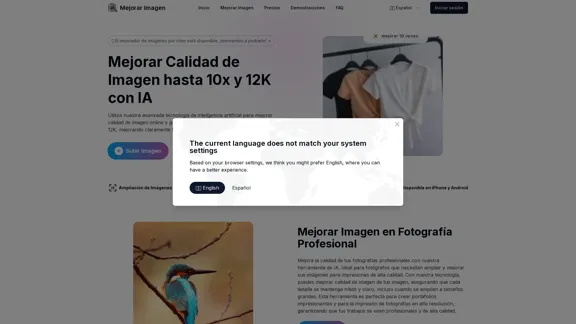
Enhance Image Quality up to 10x and 12K with AI | Improve Image

Here is the English translation: With AI, enlarge images up to 10 times and 12K resolution in seconds, to improve image quality and make your images sharper and more realistic | Enhance Image
Visit Website
Enhance Image Quality up to 10x and 12K with AI | Improve Image
Visit Website

Introduction

Mejorar Imagen is an online tool that uses advanced AI technology to enhance image quality for free. It allows users to upscale images up to 10 times and achieve resolutions of up to 12K, significantly improving sharpness and clarity.

Feature

  1. Image Upscaling

    • Enlarge images up to 10 times their original size
    • Achieve resolutions of up to 12K
  2. AI-Powered Enhancement

    • Utilizes advanced AI algorithms to intelligently add pixels
    • Improves image sharpness and clarity
  3. Multi-Platform Compatibility

    • Available on iPhone and Android devices
    • Accessible through web browsers
  4. Versatile Applications

    • Professional Photography: Enhance images for high-quality prints
    • Graphic Design: Create high-resolution images for various projects
    • Social Media: Improve image quality for better engagement
  5. User-Friendly Process

    1. Upload image
    2. Choose enhancement level
    3. Process image
    4. Download enhanced image
  6. Supported Formats

    • Compatible with JPG, JPEG, PNG, WEBP, BMP
  7. Quick Processing

    • Enhances images in seconds, depending on size and resolution
  8. PDF Support

    • Capable of enhancing images within PDF files

How to Use?

  1. For best results, start with the highest quality original image available.

  2. Experiment with different enhancement levels to find the optimal balance between size and quality.

  3. When enhancing old photos, consider adjusting contrast and color after upscaling for better results.

  4. For social media, consider the platform's recommended image sizes when upscaling.

  5. Always download your enhanced images promptly, as they are only stored on the server for one hour.

FAQ

Q: Is it really free to improve image quality? A: Yes, the tool offers a limited number of free image enhancements. Additional credits can be obtained for more and higher-level improvements.

Q: What is the maximum image enlargement and resolution possible? A: Images can be enlarged up to 10 times. The maximum supported size is 12000x12000 pixels (12K).

Q: How does the AI improve image quality? A: The AI uses advanced algorithms to intelligently add pixels, increasing resolution and improving image sharpness.

Q: Can I improve the quality of images in a PDF? A: Yes, the tool can enhance images contained in PDF files.

Q: How long does it take to improve an image's quality? A: Processing time varies depending on image size and resolution but generally takes only a few seconds.

Q: Is it safe to upload my images to the platform? A: Yes, the platform takes security seriously and ensures all uploaded images are protected.

Price

The website does not provide specific pricing information. It mentions that there are free image enhancements available, with the option to obtain additional credits for more improvements.

The price is for reference only, please refer to the latest official data for actual information.

Evaluation

  1. Mejorar Imagen offers a powerful and accessible solution for image enhancement, catering to both casual users and professionals across various fields.

  2. The ability to upscale images up to 10x and achieve 12K resolution is impressive and sets it apart from many free online tools.

  3. The multi-platform compatibility and support for various image formats, including PDFs, enhance its versatility and user-friendliness.

  4. While the tool offers free enhancements, the lack of clear pricing information for additional credits could be a point of improvement for transparency.

  5. The temporary storage of enhanced images (one hour) is a potential limitation, although it likely helps with server management and user privacy.

  6. The AI-powered enhancement technology seems promising, but without seeing actual results, it's difficult to fully assess the quality of the output compared to other professional image editing software.

Latest Traffic Insights

  • Monthly Visits

    29.48 K

  • Bounce Rate

    45.52%

  • Pages Per Visit

    1.85

  • Time on Site(s)

    40.75

  • Global Rank

    963006

  • Country Rank

    Spain 71936

Recent Visits

Traffic Sources

  • Social Media:
    3.80%
  • Paid Referrals:
    0.82%
  • Email:
    0.14%
  • Referrals:
    6.99%
  • Search Engines:
    38.38%
  • Direct:
    49.70%
More Data

Related Websites

Arbi - Amazon FBA Analyser. ChatGPT Built-In
View Detail

Arbi - Amazon FBA Analyser. ChatGPT Built-In

Arbi - Amazon FBA Analyser. ChatGPT Built-In

Analyze Amazon products with the help of a powerful AI assistant. Features include a profit calculator, Keepa charts, and more.

193.90 M
Assistree
View Detail

Assistree

Assistree

Assistree AI is an AI-powered productivity tool that helps freelancers save time and get more done on Upwork. It offers a variety...

193.90 M
YouTube Summary AI with Gemini

Gemini, Google's powerful new AI, is making waves in the world of YouTube. 

Imagine a future where YouTube videos automatically generate concise and informative summaries. That's exactly what Gemini aims to achieve.

By leveraging its advanced language understanding capabilities, Gemini can analyze video content and extract key points, creating summaries that capture the essence of the video. 

This means viewers can quickly grasp the main ideas without having to watch the entire video.

Gemini's potential applications extend beyond simple summaries. It could also be used to:

* Generate captions:  Automatically create accurate captions for videos, making them accessible to a wider audience.
* Translate videos:  Break down language barriers by translating videos into different languages.
* Create interactive experiences:  Enable viewers to engage with videos in new and innovative ways through interactive summaries and quizzes.


Gemini's arrival on YouTube promises to revolutionize the way we consume and interact with video content.
View Detail

YouTube Summary AI with Gemini Gemini, Google's powerful new AI, is making waves in the world of YouTube. Imagine a future where YouTube videos automatically generate concise and informative summaries. That's exactly what Gemini aims to achieve. By leveraging its advanced language understanding capabilities, Gemini can analyze video content and extract key points, creating summaries that capture the essence of the video. This means viewers can quickly grasp the main ideas without having to watch the entire video. Gemini's potential applications extend beyond simple summaries. It could also be used to: * Generate captions: Automatically create accurate captions for videos, making them accessible to a wider audience. * Translate videos: Break down language barriers by translating videos into different languages. * Create interactive experiences: Enable viewers to engage with videos in new and innovative ways through interactive summaries and quizzes. Gemini's arrival on YouTube promises to revolutionize the way we consume and interact with video content.

YouTube Summary AI with Gemini Gemini, Google's powerful new AI, is making waves in the world of YouTube. Imagine a future where YouTube videos automatically generate concise and informative summaries. That's exactly what Gemini aims to achieve. By leveraging its advanced language understanding capabilities, Gemini can analyze video content and extract key points, creating summaries that capture the essence of the video. This means viewers can quickly grasp the main ideas without having to watch the entire video. Gemini's potential applications extend beyond simple summaries. It could also be used to: * Generate captions: Automatically create accurate captions for videos, making them accessible to a wider audience. * Translate videos: Break down language barriers by translating videos into different languages. * Create interactive experiences: Enable viewers to engage with videos in new and innovative ways through interactive summaries and quizzes. Gemini's arrival on YouTube promises to revolutionize the way we consume and interact with video content.

AI tool powered by Gemini that summarizes YouTube videos.

193.90 M
Launch Your App in Days, Not Weeks | ShipAppFast
View Detail

Launch Your App in Days, Not Weeks | ShipAppFast

Launch Your App in Days, Not Weeks | ShipAppFast

The Swift boilerplate with all the necessary elements to bring your product to customers. From concept to production in just 5 minutes.

0
G-Data Screen Data
View Detail

G-Data Screen Data

G-Data Screen Data

Use the G-Data Screen Data extension and the g-datalabs.com platform to gather screen and facial information for training artificial intelligence.

193.90 M
AI Girlfriend Builder - Chat and Generate Images
View Detail

AI Girlfriend Builder - Chat and Generate Images

AI Girlfriend Builder - Chat and Generate Images

Create Your Dream AI Girlfriend! Customize her look and personality, and bring her to life in one click. 100% powered by Artificial Intelligence.

868.33 K
Text to Voice Generator
==========================

A text-to-voice generator, also known as a text-to-speech (TTS) system, is a software that converts written text into a spoken voice output. This technology has been widely used in various applications, including virtual assistants, audiobooks, and language learning platforms.

How it Works
---------------

The process of generating voice from text involves several steps:

1. Text Analysis: The input text is analyzed to identify the language, syntax, and semantics.
2. Phonetic Transcription: The text is converted into a phonetic transcription, which represents the sounds of the spoken language.
3. Prosody Generation: The phonetic transcription is then used to generate the prosody, or rhythm and intonation, of the spoken voice.
4. Waveform Generation: The prosody and phonetic transcription are combined to generate the audio waveform, which is the final spoken voice output.

Types of Text-to-Voice Generators
-----------------------------------

There are two main types of text-to-voice generators:

Rule-Based Systems

These systems use a set of predefined rules to generate the spoken voice output. They are often limited in their ability to produce natural-sounding voices and may sound robotic.

Machine Learning-Based Systems

These systems use machine learning algorithms to learn from large datasets of spoken voices and generate more natural-sounding voices. They are often more advanced and can produce high-quality voice outputs.

Applications of Text-to-Voice Generators
-----------------------------------------

Text-to-voice generators have a wide range of applications, including:

Virtual Assistants

Virtual assistants, such as Siri and Alexa, use text-to-voice generators to respond to user queries.

Audiobooks

Text-to-voice generators can be used to create audiobooks from written texts, making it easier for people to access written content.

Language Learning

Language learning platforms use text-to-voice generators to provide pronunciation guidance and practice exercises for learners.

Accessibility

Text-to-voice generators can be used to assist people with disabilities, such as visual impairments, by providing an auditory interface to written content.
View Detail

Text to Voice Generator ========================== A text-to-voice generator, also known as a text-to-speech (TTS) system, is a software that converts written text into a spoken voice output. This technology has been widely used in various applications, including virtual assistants, audiobooks, and language learning platforms. How it Works --------------- The process of generating voice from text involves several steps: 1. Text Analysis: The input text is analyzed to identify the language, syntax, and semantics. 2. Phonetic Transcription: The text is converted into a phonetic transcription, which represents the sounds of the spoken language. 3. Prosody Generation: The phonetic transcription is then used to generate the prosody, or rhythm and intonation, of the spoken voice. 4. Waveform Generation: The prosody and phonetic transcription are combined to generate the audio waveform, which is the final spoken voice output. Types of Text-to-Voice Generators ----------------------------------- There are two main types of text-to-voice generators: Rule-Based Systems These systems use a set of predefined rules to generate the spoken voice output. They are often limited in their ability to produce natural-sounding voices and may sound robotic. Machine Learning-Based Systems These systems use machine learning algorithms to learn from large datasets of spoken voices and generate more natural-sounding voices. They are often more advanced and can produce high-quality voice outputs. Applications of Text-to-Voice Generators ----------------------------------------- Text-to-voice generators have a wide range of applications, including: Virtual Assistants Virtual assistants, such as Siri and Alexa, use text-to-voice generators to respond to user queries. Audiobooks Text-to-voice generators can be used to create audiobooks from written texts, making it easier for people to access written content. Language Learning Language learning platforms use text-to-voice generators to provide pronunciation guidance and practice exercises for learners. Accessibility Text-to-voice generators can be used to assist people with disabilities, such as visual impairments, by providing an auditory interface to written content.

Text to Voice Generator ========================== A text-to-voice generator, also known as a text-to-speech (TTS) system, is a software that converts written text into a spoken voice output. This technology has been widely used in various applications, including virtual assistants, audiobooks, and language learning platforms. How it Works --------------- The process of generating voice from text involves several steps: 1. Text Analysis: The input text is analyzed to identify the language, syntax, and semantics. 2. Phonetic Transcription: The text is converted into a phonetic transcription, which represents the sounds of the spoken language. 3. Prosody Generation: The phonetic transcription is then used to generate the prosody, or rhythm and intonation, of the spoken voice. 4. Waveform Generation: The prosody and phonetic transcription are combined to generate the audio waveform, which is the final spoken voice output. Types of Text-to-Voice Generators ----------------------------------- There are two main types of text-to-voice generators: Rule-Based Systems These systems use a set of predefined rules to generate the spoken voice output. They are often limited in their ability to produce natural-sounding voices and may sound robotic. Machine Learning-Based Systems These systems use machine learning algorithms to learn from large datasets of spoken voices and generate more natural-sounding voices. They are often more advanced and can produce high-quality voice outputs. Applications of Text-to-Voice Generators ----------------------------------------- Text-to-voice generators have a wide range of applications, including: Virtual Assistants Virtual assistants, such as Siri and Alexa, use text-to-voice generators to respond to user queries. Audiobooks Text-to-voice generators can be used to create audiobooks from written texts, making it easier for people to access written content. Language Learning Language learning platforms use text-to-voice generators to provide pronunciation guidance and practice exercises for learners. Accessibility Text-to-voice generators can be used to assist people with disabilities, such as visual impairments, by providing an auditory interface to written content.

Generate Voice from Text on Any Web Page With the advancement of technology, it is now possible to generate voice from text on any web page. This feature is particularly useful for people who prefer listening to content rather than reading it. Here's how you can do it: #Method 1: Using Browser Extension You can use a browser extension like Read Aloud or SpeakIt! to generate voice from text on any web page. These extensions are available for both Google Chrome and Mozilla Firefox browsers. #Method 2: Using Online Tools There are several online tools available that can convert text to speech. Some popular tools include NaturalReader, Voice Dream Reader, and Google Text-to-Speech. You can copy and paste the text from any web page into these tools to generate voice. #Method 3: Using Screen Reader If you are using a Windows operating system, you can use the built-in Narrator screen reader to generate voice from text on any web page. For Mac users, you can use VoiceOver. By using any of these methods, you can easily generate voice from text on any web page and enjoy a more convenient and accessible reading experience.

193.90 M
Mp3Converter AI
View Detail

Mp3Converter AI

Mp3Converter AI

Experience high-quality, efficient audio conversions with our AI-powered MP3 Converter. Convert any format to MP3 with unmatched speed and precision. Transform your audio effortlessly!

0