Open-source RightAI Tools Directory
  • Discover AI
  • Submit
  • Startup
  • Blog
Open-source RightAI Tools Directory
Discover the best AI tools of 2025 with the RightAI Tools Directory!

Friend Links

AI Anime GeneratorToolsApp AI

Support

Tap4
Privacy policyTerms & ConditionsContact Us
Loading...
loading...

Coachpilot

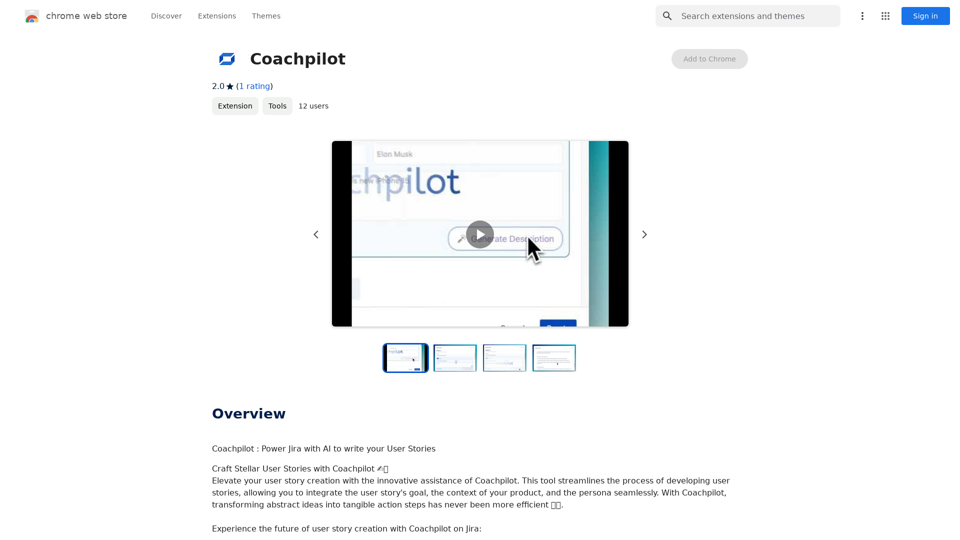
Coachpilot: Use AI to Write User Stories in Jira Coachpilot helps you write better user stories in Jira using the power of artificial intelligence.
Visit Website
Coachpilot
Visit Website

Introduction

Coachpilot is an innovative AI-powered tool designed to streamline the creation of user stories for Jira. It utilizes intelligent forms and AI-driven assistance to help users define goals, context, and personas, generating comprehensive and precise user stories with a single click. This tool aims to enhance productivity and improve the quality of user stories in project management workflows.

Feature

Intelligent Forms

Coachpilot's smart forms guide users in defining the goal, context, and persona of their user stories. These forms are designed to capture essential information, enabling the AI to craft tailored and accurate user stories.

Instant User Story Generation

With just one click on the "Generate" button, Coachpilot's AI synthesizes a user story based on the provided inputs. This feature significantly reduces the time spent on story creation.

Jira Embedded Integration

Seamlessly integrate Coachpilot into Jira, allowing users to create, edit, and refine user stories without leaving their project management environment. This integration enhances workflow efficiency.

Guided User Story Craft

The AI-powered prompts assist users throughout the story creation process, ensuring clarity and precision. This feature acts as a story assistant, guiding users even if they're unsure how to start.

Flexible Formats (Coming Soon)

Coachpilot will adapt to various story formats, including epics, tasks, and specific user stories. The AI adjusts its output based on the provided context, catering to diverse project requirements.

FAQ

How does Coachpilot work?

Coachpilot uses intelligent forms and AI-driven assistance to help you define goals, context, and personas. It then generates comprehensive and precise user stories with just one click, streamlining the entire process.

What are the main benefits of using Coachpilot?

The key benefits include:

  • Time-saving through instant user story generation
  • Improved productivity with Jira integration
  • Enhanced quality of user stories through AI-guided creation
  • Flexibility in story formats (coming soon)

Is Coachpilot easy to use?

Yes, Coachpilot is designed for ease of use. The process involves:

  1. Defining goal, context, and persona using intelligent forms
  2. Inputting parameters and clicking "Generate"
  3. Reviewing and refining the generated user story
  4. Integrating with Jira for seamless collaboration

What pricing options does Coachpilot offer?

Coachpilot offers an affordable subscription model, though specific pricing details are not provided in the given information. It's recommended to check their official website or contact their sales team for current pricing options.

Latest Traffic Insights

  • Monthly Visits

    193.90 M

  • Bounce Rate

    56.27%

  • Pages Per Visit

    2.71

  • Time on Site(s)

    115.91

  • Global Rank

    -

  • Country Rank

    -

Recent Visits

Traffic Sources

  • Social Media:
    0.48%
  • Paid Referrals:
    0.55%
  • Email:
    0.15%
  • Referrals:
    12.81%
  • Search Engines:
    16.21%
  • Direct:
    69.81%
More Data

Related Websites

GPT Search Navigator
View Detail

GPT Search Navigator

GPT Search Navigator

Get instant, relevant answers to all your Google searches!

193.90 M
Plant Identifier: Free Scan on the App Store
View Detail

Plant Identifier: Free Scan on the App Store

Plant Identifier: Free Scan on the App Store

Use your camera or a picture to quickly identify plants with AI. Perfect for gardeners, nature lovers, and anyone curious about the plants around them. Features: * Instantly identify plants using AI-powered image recognition technology * Browse a vast database of plants from around the world * Learn about plant care, habitat, and other interesting facts * Snap a photo or upload an image to identify plants in seconds * Explore plant families, genera, and species to expand your knowledge * Create a personalized plant journal to track your discoveries

124.77 M
Kling AI | KuaiShou Text-to-Video Generation Model
View Detail

Kling AI | KuaiShou Text-to-Video Generation Model

Kling AI | KuaiShou Text-to-Video Generation Model

Discover Kling AI, a revolutionary Sora-like text-to-video model. Create stunning videos with advanced 3D mechanisms and cinema-grade quality.

21.14 K
STAIRAZ 

Job Application Tracker, Resume Builder, Job Analysis
View Detail

STAIRAZ Job Application Tracker, Resume Builder, Job Analysis

STAIRAZ Job Application Tracker, Resume Builder, Job Analysis

STAIRAZ Job Application Tracker: A professional tool that simplifies your job search and increases your chances of getting hired.

193.90 M
AIDEA
View Detail

AIDEA

AIDEA

Interfacing with AI This document explores the various ways humans interact with artificial intelligence (AI). Types of Interfaces * Text-based Interfaces: These interfaces allow users to communicate with AI systems through written language. * Examples include chatbots, command-line interfaces, and search engines. * Voice-based Interfaces: Users interact with AI using spoken words. * Examples include virtual assistants like Siri, Alexa, and Google Assistant. * Graphical User Interfaces (GUIs): These interfaces use visual elements like icons, buttons, and menus to enable interaction with AI. * Examples include AI-powered image editing software and virtual reality experiences. * Gesture-based Interfaces: Users control AI systems through physical movements. * Examples include motion-controlled gaming and sign language recognition. Challenges of AI Interfacing * Natural Language Understanding (NLU): AI systems struggle to fully understand the nuances of human language. * Contextual Awareness: AI often lacks the ability to understand the broader context of a conversation or interaction. * Personalization: Creating AI interfaces that are tailored to individual user preferences and needs can be complex. * Ethical Considerations: * Bias in AI algorithms can lead to unfair or discriminatory outcomes. * Privacy concerns arise when AI systems collect and process personal data. Future of AI Interfacing * More Natural and Intuitive Interactions: Advancements in NLU and machine learning will lead to AI systems that can understand and respond to human input more naturally. * Multi-modal Interfaces: Future interfaces will likely combine multiple input methods (e.g., text, voice, gesture) for a richer and more immersive experience. * Personalized AI Assistants: AI assistants will become increasingly personalized, anticipating user needs and providing customized support. * Ethical AI Development: * Researchers and developers will continue to work on mitigating bias and ensuring responsible use of AI.

193.90 M
Chrome Web Store
View Detail

Chrome Web Store

Chrome Web Store

Enhance your browser with new features and customize your browsing experience.

193.90 M
Hints Playbook AI

This playbook provides guidance on how to effectively use hints to improve the performance of AI models.

Understanding Hints

Hints are additional pieces of information provided to an AI model to guide its output. They can take various forms, such as:

* Textual prompts: Direct instructions or suggestions.
* Examples: Demonstrating the desired output format or style.
* Constraints: Specifying limitations or boundaries for the response.

Types of Hints

* Zero-shot: Hints are provided without any examples.
* Few-shot: A small number of examples are given to illustrate the desired output.
* Fine-tuning: Hints are incorporated into the training data to adjust the model's behavior.

Best Practices for Using Hints

* Be specific: Clearly articulate what you want the AI to do.
* Provide context: Give the model enough background information to understand the task.
* Use examples: Demonstrate the desired output format or style.
* Iterate and refine: Experiment with different types and formats of hints to find what works best.
* Evaluate results: Assess the quality of the AI's output and adjust hints accordingly.
View Detail

Hints Playbook AI This playbook provides guidance on how to effectively use hints to improve the performance of AI models. Understanding Hints Hints are additional pieces of information provided to an AI model to guide its output. They can take various forms, such as: * Textual prompts: Direct instructions or suggestions. * Examples: Demonstrating the desired output format or style. * Constraints: Specifying limitations or boundaries for the response. Types of Hints * Zero-shot: Hints are provided without any examples. * Few-shot: A small number of examples are given to illustrate the desired output. * Fine-tuning: Hints are incorporated into the training data to adjust the model's behavior. Best Practices for Using Hints * Be specific: Clearly articulate what you want the AI to do. * Provide context: Give the model enough background information to understand the task. * Use examples: Demonstrate the desired output format or style. * Iterate and refine: Experiment with different types and formats of hints to find what works best. * Evaluate results: Assess the quality of the AI's output and adjust hints accordingly.

Hints Playbook AI This playbook provides guidance on how to effectively use hints to improve the performance of AI models. Understanding Hints Hints are additional pieces of information provided to an AI model to guide its output. They can take various forms, such as: * Textual prompts: Direct instructions or suggestions. * Examples: Demonstrating the desired output format or style. * Constraints: Specifying limitations or boundaries for the response. Types of Hints * Zero-shot: Hints are provided without any examples. * Few-shot: A small number of examples are given to illustrate the desired output. * Fine-tuning: Hints are incorporated into the training data to adjust the model's behavior. Best Practices for Using Hints * Be specific: Clearly articulate what you want the AI to do. * Provide context: Give the model enough background information to understand the task. * Use examples: Demonstrate the desired output format or style. * Iterate and refine: Experiment with different types and formats of hints to find what works best. * Evaluate results: Assess the quality of the AI's output and adjust hints accordingly.

Hints automatically updates CRM fields from video calls. Keep your CRM up-to-date.

193.90 M
Gmail Bot
View Detail

Gmail Bot

Gmail Bot

Ask ChatGPT about your Gmail messages

193.90 M