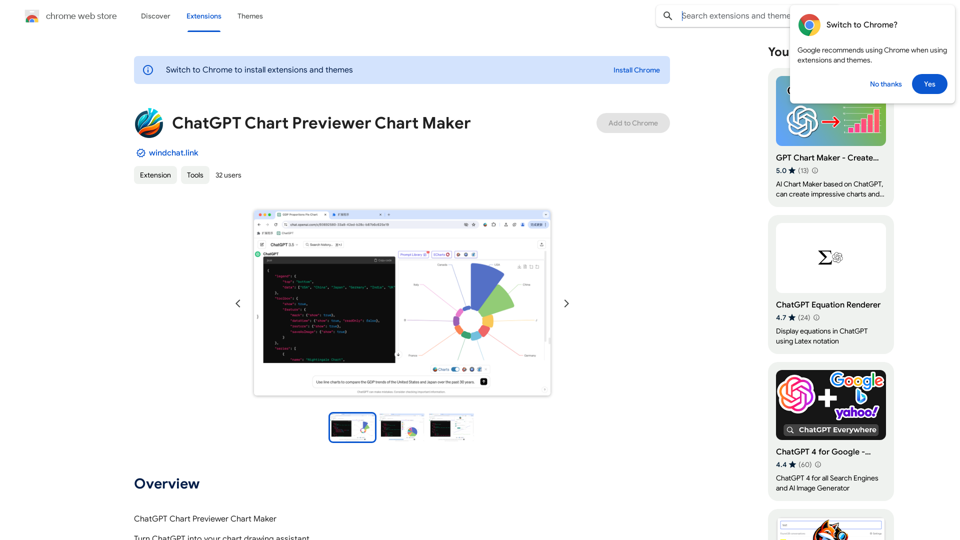
ChatGPT Chart Previewer Chart Maker is an extension that enables users to create various types of charts and graphs using ChatGPT. This tool simplifies the process of data visualization, allowing users to generate beautiful, high-quality graphics for a wide range of applications. Whether you need to visualize economic data, population statistics, or custom datasets, this extension offers a user-friendly solution for creating compelling visual representations.
ChatGPT Chart Previewer Chart Maker
ChatGPT Chart Previewer Chart Maker
Introduction
Feature
Create Diverse Chart Types
ChatGPT Chart Previewer Chart Maker supports over 100 types of graphics, including line charts, bar charts, pie charts, and more. This versatility ensures that users can find the perfect visualization for any dataset or application scenario.
Data-Driven Visualization
Users can input their own data and specify requirements to ChatGPT, which then generates instant, visually appealing graphics. This feature allows for quick and easy creation of custom charts based on user-provided information.
Web-Based Data Retrieval
Leveraging ChatGPT's web browsing capability, users can simply state their request to obtain the latest visualized data results. This feature is particularly useful for accessing and visualizing up-to-date information from online sources.
High-Quality Output
The extension allows users to download graphics as high-definition images, making them suitable for use in presentations, documents, web pages, and various other applications.
Customization Options
Users can experiment with different chart types and customize the appearance of their visualizations to best suit their needs and preferences.
FAQ
What types of charts can I create with this extension?
The extension supports a wide variety of chart types, including line charts, bar charts, pie charts, and many more. It covers over 100 types of graphics to suit different visualization needs.
Can I use my own data with ChatGPT Chart Previewer Chart Maker?
Yes, you can input your own data and specify your requirements to ChatGPT, which will then generate visualizations based on your custom dataset.
Is it possible to access and visualize the latest data from online sources?
Absolutely. The extension utilizes ChatGPT's web browsing capability, allowing you to request and visualize the most recent data available online.
How can I use the charts created with this extension?
You can download the generated graphics as high-definition images and use them in various applications such as PowerPoint presentations, documents, websites, and more.
Is there a cost associated with using ChatGPT Chart Previewer Chart Maker?
The pricing information for this extension is not specified in the provided content.
Related Websites

The intelligent notebook for world creators - Notebook.ai
The intelligent notebook for world creators - Notebook.aiNotebook.ai is a collection of tools designed for writers and roleplayers to create magnificent universes — and everything within them.
149.28 K

Master math effortlessly! Step-by-step solutions for arithmetic, algebra, trigonometry, and geometry. Instant Snap & Ask, rich materials, diverse practice. Simplify math with Math Sniper – where precision meets simplicity!
0

WhatToTextAi =============== WhatToTextAi is an AI-powered texting assistant that helps you come up with the perfect response to any situation.
WhatToTextAi =============== WhatToTextAi is an AI-powered texting assistant that helps you come up with the perfect response to any situation.Overcome texting anxiety with WhatToText AI. Get personalized, human-like replies for any situation in seconds. Improve your English texting skills and build deeper connections. Perfect for non-native speakers and anyone looking to enhance their messaging game.
0

Buffup - AI Copilot of ChatGPT4 & Claude3 with 1,000+ bots
Buffup - AI Copilot of ChatGPT4 & Claude3 with 1,000+ botsAI Copilot of ChatGPT4 & Claude3 with 1K+ bots, GPTs, Internet Connectivity, Translation, Summarization This AI copilot combines the power of ChatGPT4 and Claude3, along with over 1,000 bots, GPTs, and internet connectivity, to provide advanced features such as translation and summarization.
193.90 M



Stability Matrix CivitAI Integration This document outlines the integration of Stability Matrix into Civitai. What is Stability Matrix? Stability Matrix is a powerful tool for evaluating and comparing different AI models. It provides a comprehensive set of metrics to assess model performance across various tasks, including text generation, image generation, and code generation. Benefits of Integrating Stability Matrix into Civitai: * Enhanced Model Discovery: Users can easily identify high-performing models based on their desired tasks and preferences. * Improved Model Selection: The detailed metrics provided by Stability Matrix allow for informed decision-making when choosing a model for a specific project. * Community-Driven Evaluation: By leveraging the collective wisdom of the Civitai community, Stability Matrix fosters a transparent and collaborative approach to model evaluation. * Accelerated Model Development: Developers can use Stability Matrix to track the progress of their models and identify areas for improvement. Implementation Details: * Stability Matrix scores will be displayed alongside model descriptions on Civitai. * Users will be able to filter models based on their Stability Matrix scores. * The integration will initially focus on text generation and image generation models. Future Enhancements: * Expand support for additional model types, such as code generation models. * Implement interactive visualizations of Stability Matrix data. * Allow users to contribute their own model evaluations to the platform.
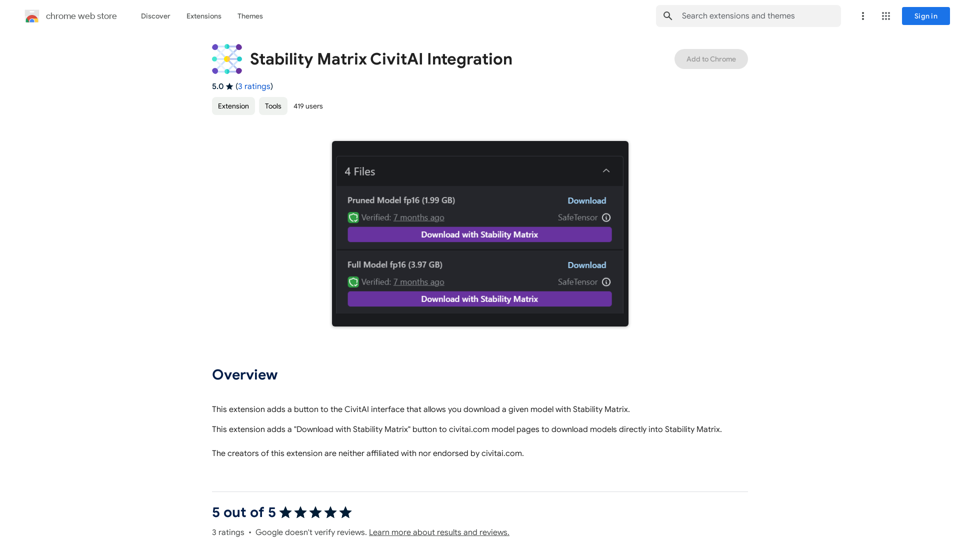
Stability Matrix CivitAI Integration This document outlines the integration of Stability Matrix into Civitai. What is Stability Matrix? Stability Matrix is a powerful tool for evaluating and comparing different AI models. It provides a comprehensive set of metrics to assess model performance across various tasks, including text generation, image generation, and code generation. Benefits of Integrating Stability Matrix into Civitai: * Enhanced Model Discovery: Users can easily identify high-performing models based on their desired tasks and preferences. * Improved Model Selection: The detailed metrics provided by Stability Matrix allow for informed decision-making when choosing a model for a specific project. * Community-Driven Evaluation: By leveraging the collective wisdom of the Civitai community, Stability Matrix fosters a transparent and collaborative approach to model evaluation. * Accelerated Model Development: Developers can use Stability Matrix to track the progress of their models and identify areas for improvement. Implementation Details: * Stability Matrix scores will be displayed alongside model descriptions on Civitai. * Users will be able to filter models based on their Stability Matrix scores. * The integration will initially focus on text generation and image generation models. Future Enhancements: * Expand support for additional model types, such as code generation models. * Implement interactive visualizations of Stability Matrix data. * Allow users to contribute their own model evaluations to the platform.This extension adds a button to the CivitAI interface that allows you to download a given model with Stability Matrix.
193.90 M